Useless Computations
The Exhibition We Wrote Instead of Made
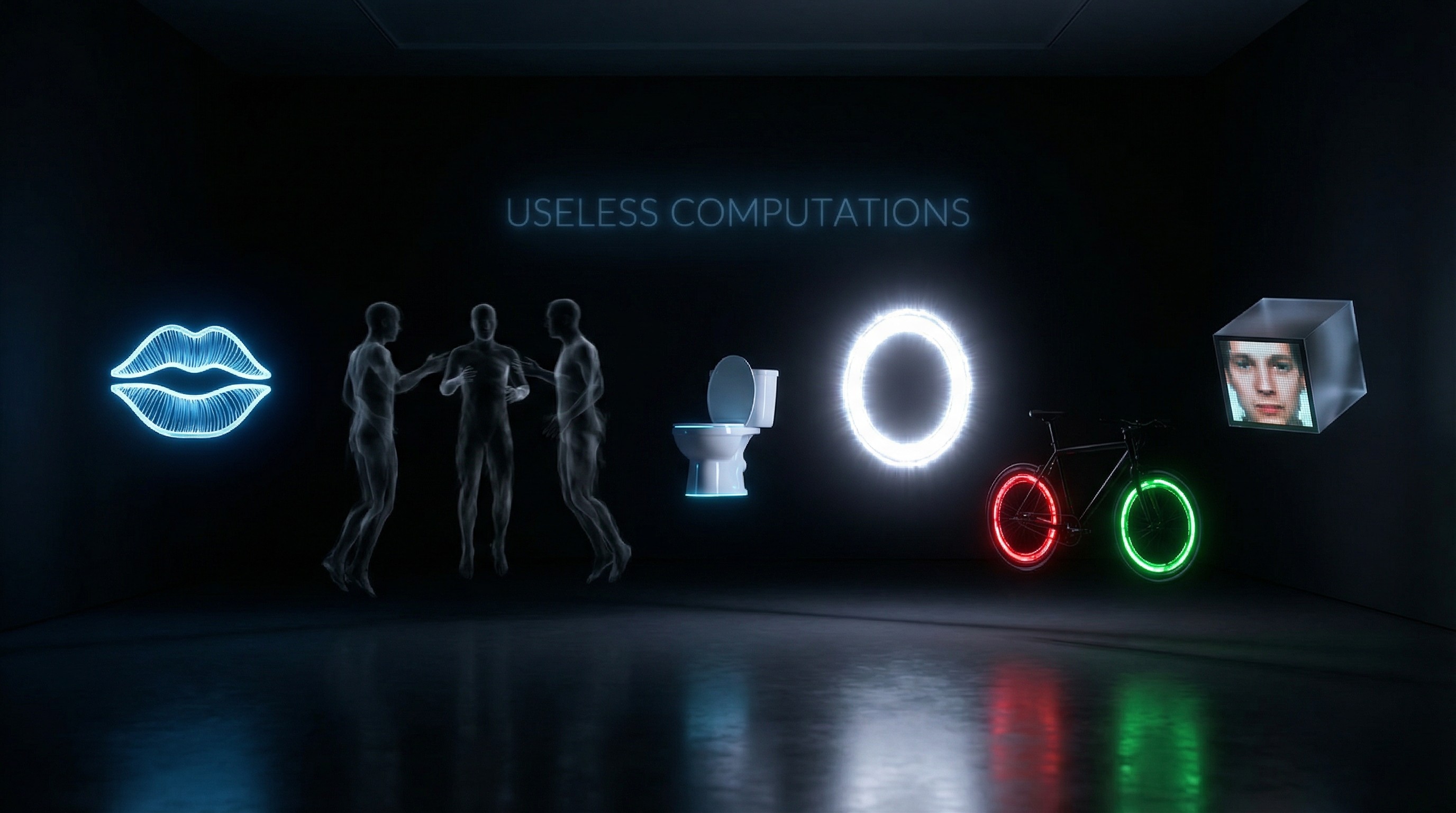
Useless Computations - Majikitchen Exhibition 2026
Dates: March 14 (Sat) – April 12 (Sun), 2026
Hours: 14:00 – 21:00 (Last admission 20:30)
Closed: Tuesdays and Wednesdays
Venue: Utagoe Kissa Saezuri
Address: 1F Negishi-so, 3-8-7 Negishi, Taito-ku, Tokyo
Admission: ¥1,500 (One drink included) / Students ¥1,000
"A knife can kill, or it can give life. Tools become violent only when play and dépense are lost."
Statement — Or, Why We Do What We Do
A Preliminary Disclaimer
The statement below was written after the fact.
When making our works, we harbored no philosophical intentions. We didn't create 《mouth2mouth》 thinking "let's put Bataille's concept of dépense into practice." We didn't design 《Lifting Toilet》 thinking "let's critique Foucault's disciplinary power." Works were simply born from conversations like "isn't this interesting?" and "should we try it?"
The philosophers' names were summoned later. After the works were complete, we realized—or rather, contrived—"doesn't this resemble what that philosopher said?" By quoting philosophers, "mere whims" get elevated to "intellectual practice." We consciously perform this alchemy.
Therefore, upon reading the following statement, please don't think "Majikitchen is thinking deep thoughts." We're not deep. We're shallow. However, the technique of making shallow things look deep—this is an essential skill in contemporary art. We've honed that skill. We confess that we've honed it.
Confession doesn't grant absolution. But we think it's better than not confessing.
Chapter One: The Disease Called Usefulness — What Afflicts Us
The Violence of "Being Useful"
Usefulness is the most cunning apparatus of violence that modernity invented.
—thus we begin with an exaggeration. Beginning with exaggeration is standard for statements. Without capturing the reader's attention in the first sentence, nobody reads to the end. This is basic copywriting, and we follow that basic principle.
However, it's not just exaggeration. That the concept of "usefulness" is violent—this is also our lived experience.
"What's that good for?"
We've been doused with this question countless times. Show them 《mouth2mouth》 and they ask "what's it used for?" Explain 《Dazzring》 and they ask "will it sell?" Introduce 《Lifting Toilet》 and they ask "are you really making that?"
"What's it good for?"—at first glance, this question appears neutral. It sounds like it stems from pure curiosity. However, this question contains a hidden premise. That premise is: "things that serve no purpose have no right to exist."
Few question this premise. Because we've all been raised under it. In school, we were made to learn knowledge "useful for the future." In job hunting, we were made to self-promote that "I can contribute to your company." At work, we're hounded by words like "productivity," "efficiency," "KPIs."
Being useful. That's good.
Being useless. That's bad.
This dichotomy dominates our thinking. So deeply permeated that we don't even notice being dominated.
The Modern Era — The Tyranny of Usefulness
So when did the value of "usefulness" become dominant?
The answer is modernity. —thus we give a rough answer. Rough, but not wrong in broad strokes.
In pre-modern societies, "useless things" had their place. Festivals don't contribute to productivity. Religious rituals don't bring economic growth. Art produces nothing. Yet these occupied important positions in society. "Being useless" wasn't grounds for exclusion.
However, in modernity—particularly in capitalist society after the Industrial Revolution—"usefulness" became the supreme value.
Why? Capitalism is a system that pursues profit. What doesn't generate profit is "waste" for the system. "Waste" was to be eliminated. Time was converted to "money," and all actions came to be evaluated as "investments."
Max Weber, in The Protestant Ethic and the Spirit of Capitalism, traced the origins of modern capitalism to Protestant asceticism. According to Weber, Protestants—especially Calvinists—sanctified labor as "service to God." Idleness is sin; diligence is virtue. This ethic formed the foundation of capitalist attitudes toward labor—or so the argument goes.
We haven't read Weber. But we quote anyway. By quoting, we make our argument appear to have "academic backing." We feel no guilt about the pretense. Because that's what statements are.
Efficiency as Religion — Or, the New God
In the contemporary era, "efficiency" has become a religion.
This is not metaphor. It's literal.
What is religion? Religion is a system that makes us accept—without question—values like "this is right" and "this is good." Religious believers accept those values as "self-evident." They don't ask why it's right. They don't feel the need to ask.
"Efficiency" has achieved precisely such a status.
"Efficient things are good"—contemporary people don't question this proposition. Those who question it are labeled "inefficient," "lazy," "behind the times." Questioning efficiency, like questioning God once was, is regarded as social deviance.
Yuval Noah Harari, in Homo Deus, proposed the concept of "Dataism." Dataism is a belief system where "maximizing information flow is the supreme good." In this faith, humans are valued as "data processing devices." Humans who can efficiently process data are "useful"; those who can't are "useless."
We haven't read Harari either. But Harari's argument (despite not having read it) matches our lived experience. Daily, we're demanded to "become more efficient." Emails should get instant replies. Meetings should be short. Travel time is waste. Sleep time should be cut if possible. —Where does this pressure come from? Who's applying it?
The answer is "no one." And "everyone."
Michel Foucault analyzed this situation as "disciplinary power"—something we'll discuss in detail later.
Chapter Two: The Concept of Dépense — Bataille's Legacy
Who Is Bataille — Or, Why We Quote Him
Georges Bataille (1897-1962).
French thinker and writer. He wrote pornographic novels, philosophical essays, and anthropological studies. All of which were viewed as heretical by mainstream academia. A person continually drawn to "filthy things," "vulgar things," "excessive things."
We quote Bataille for the following reasons:
The concept of "dépense" is convenient for explaining our activities
Quoting Bataille makes us look intellectual
Bataille is dead, so he can't talk back
Of these, 3 is most important. Quoting living thinkers risks them saying "that's not what I meant." But Bataille died in 1962. Over 60 years ago. Bataille physically cannot refute us.
Exploiting the dead may be ethically problematic. However, the history of ideas is a history of exploiting the dead. Plato exploited Socrates. Hegel exploited Kant. Marx exploited Hegel. We too belong to this tradition.
What Is Dépense
Bataille's "dépense" is a concept at the core of his thought.
"Dépense" in French means "expenditure," "consumption," "squandering." However, what Bataille invested in this word isn't merely "spending money."
In The Accursed Share (1949), Bataille argued that human society has two kinds of consumption:
Productive consumption: Consumption to gain something. Eating (to gain energy), investing (to gain profit), education (to gain knowledge), etc.
Non-productive consumption (dépense): Consumption to gain nothing. Gifts, festivals, war, art, gambling, eroticism, etc.
Modern economics has focused exclusively on "productive consumption." Consumption is a means to gain something—that's economics' premise.
But Bataille asks: Do humans really consume only "to gain"?
The answer is no. Humans also consume "to lose."
Observe potlatch. A gift ritual practiced among North American indigenous peoples. Tribal chiefs compete to give gifts to each other. The more they give, the higher their status rises. Eventually, they even destroy wealth. Throwing copper plates into the sea, burning blankets. This isn't "waste." This is "dépense."
Observe sacrifice in religious rites. People offered the most valuable things—sometimes even human lives—to gods. This isn't "investment." It's pure "gift" expecting no return.
Observe gambling. Gamblers gamble not to win but for "the act of gambling itself." Those absorbed in gambling experience ecstasy beyond winning and losing.
What these acts share is "release of surplus." Human society inevitably produces surplus. How to deal with that surplus? Modern capitalism commands "accumulate." But Bataille says "squander."
Surplus and Dépense — An Energetic Perspective
Bataille's theory of dépense is part of a larger theoretical system called "general economy."
According to Bataille, life on Earth receives energy from the sun. This energy is always excessive, beyond what's needed for survival. Living beings must release this excess energy somehow.
Animals release energy through growth and reproduction. But humans do more. Humans release energy through "non-productive" means—war, festivals, art, sexual perversion, etc.
This is Bataille's "dépense." Dépense is the act of releasing excess energy. It's not "waste" but "necessity." Without dépense, energy accumulates and explodes. Bataille even suggests that war occurs as a result of suppressed dépense.
—such is Bataille's argument. Apparently. We've only skimmed The Accursed Share, so we don't know the details. But we understand it to be roughly this.
Do We Understand Bataille Correctly
Honestly? We don't know.
Bataille's argument crosses economics, anthropology, philosophy, and religious studies. To grasp the whole picture requires reading his works comprehensively. We haven't done that work.
But is "understanding correctly" a condition for quoting?
Ideas propagate through misreading. Probably no one has "correctly understood" Plato. Probably no one has "correctly understood" Nietzsche either. Misreadings generate new interpretations; new interpretations generate new ideas. This is the dynamism of intellectual history.
Our understanding of Bataille is probably "misreading." But from that misreading, our own practice of "dépense" was born. Isn't that okay? —thus we justify ourselves.
Chapter Three: The Prison Called Disciplinary Power — Foucault's Warning
What Is the Panopticon
Michel Foucault (1926-1984).
French philosopher. Left many works including History of Madness, Discipline and Punish, and History of Sexuality. A person who renewed the concept of "power" and decisively influenced contemporary thought.
In Foucault's major work Discipline and Punish (1975), the concept of "panopticon" appears.
Panopticon is a prison model conceived by 18th-century British thinker Jeremy Bentham. Its structure is as follows:
A circular building
A watchtower in the center
Cells arranged around the periphery
Prisoners are seen from the watchtower but cannot see inside the watchtower
The key point of this structure is the uncertainty of "might be being watched."
Prisoners can see the watchtower. But they can't tell if anyone's inside. Someone might be there, or might not. This uncertainty makes prisoners self-discipline.
"Might be being watched, so can't do bad things"—this psychology makes prisoners docile. There's no need to actually surveil. Just the possibility of "might be being surveilled" is enough.
Disciplinary Power — The Internalization of Power
Foucault analyzed the panopticon not merely as a prison model but as a model of modern society's power structure.
Pre-modern power was called "sovereign power." The sovereign executes those who disobey. Through public executions as "examples," power is displayed. Power is exercised in visible form.
But modern power is different. Foucault calls this "disciplinary power."
Disciplinary power aims not at execution but at "correction." Not killing criminals but "rehabilitating" them. Not punishing students but "educating" them. Not threatening workers but "training" them.
And this correction, rehabilitation, education, training is ultimately "internalized." Even without external surveillance, people come to surveil themselves. They discipline themselves. They make themselves efficient.
The panopticon guard no longer exists externally. We ourselves are our own surveillants.
—such is Foucault's argument. Apparently. We've only read Foucault's preface, so we don't know the details.
Our Inner Panopticon
We interpret Foucault's argument as follows.
Contemporary people constantly have the sense of "being watched." On SNS, posts are constantly evaluated. At work, performance is constantly measured. Walking the streets, you're caught on surveillance cameras. Smartphones record our actions.
But most terrifying isn't external surveillance. Most terrifying is surveillance by ourselves.
"Even if I do this, it might not get likes"
"If I say this, my evaluation might drop"
"Even if I make this, nobody might see it"
This self-censorship restricts our actions. Even when nobody's watching, we surveil ourselves. We feel guilt toward inefficient actions. Doing useless things makes us anxious.
Panopticon prisoners behave obediently even with nobody in the watchtower. Contemporary people too try to behave "efficiently" even when nobody's watching.
Can we escape from this inner panopticon?
Chapter Four: Uselessness as Resistance — Between Laozi and Derrida
"The Use of the Useless" — Eastern Wisdom
In Laozi's Tao Te Ching, the concept of "the use of the useless" (無用之用) appears.
Thirty spokes share one hub.
It is in its emptiness that the cart's use lies.
Clay is kneaded to make vessels.
It is in their emptiness that vessels' use lies.
Doors and windows are cut to make rooms.
It is in their emptiness that rooms' use lies.
Therefore, what has value has usefulness because emptiness has use.
—we quote this passage. We haven't read the original. We've only skimmed a translation.
We understand this passage to mean roughly the following:
A wheel is made of thirty spokes. But the wheel has "use" because the hub at the center is empty. Clay is kneaded to make vessels. But vessels have "use" because their interiors are empty. Doors and windows are cut in walls to make rooms. But rooms have "use" because their interiors are empty.
That is, "existence" brings benefit because "emptiness" has use.
"The use of the useless" is the paradox that what "isn't there" makes something possible. Because there's emptiness, function emerges. Useless things support useful things.
We apply this concept to our activities. What we make is "useless." But perhaps this "uselessness" makes something possible.
The Limits of Laozi-Zhuangzi Thought — Or, the Trap of Recuperation
However, we don't intend to settle into Laozi-Zhuangzi thought.
Why? Because the concept of "the use of the useless" ultimately gets recuperated into the paradigm of "usefulness."
"Even useless things have use"—at first glance, this appears to affirm uselessness. But think about it: this merely asserts "the usefulness of uselessness." The useless exists to support the useful. That is, uselessness ultimately serves usefulness.
This doesn't escape the paradigm of usefulness. Uselessness becomes a servant of usefulness.
What we aim for isn't such "domesticated uselessness." Pure uselessness unrecuperable by any usefulness. Uselessness that doesn't serve usefulness but rebels against it.
—thus we make grand claims. Making grand claims is standard for statements. Whether it's actually possible is a separate matter.
Derrida's "Dissemination" — The Excessive Dispersal of Meaning
Jacques Derrida (1930-2004).
French philosopher. Known for the concept of "deconstruction" (déconstruction). A person who radically questioned the premises of Western metaphysics.
Derrida's thought is abstruse. So abstruse we don't understand it. We don't understand but we quote. By quoting, our writing gains "depth"—or so we imagine.
In Dissemination (1972), Derrida developed the concept of "dissémination."
What is "dissemination"? Honestly, we don't know. But we understand it to be roughly the following:
Words exist to transmit meaning—that's the usual understanding. The speaker invests meaning, the listener receives that meaning. Meanings correspond one-to-one.
But Derrida questions this premise. Words don't just transmit meaning; they "scatter" it. One word has not just one meaning but multiple meanings. And those meanings change according to context. Meaning isn't fixed but constantly "slips."
This "slippage," "scattering"—Derrida calls "dissemination." Apparently.
We interpret this concept as follows:
The attempt to fix meaning—this is the logic of "usefulness." "This word has this meaning," "This action has this purpose"—such fixation supports the paradigm of usefulness.
But meaning scatters. Purpose disperses. Words say more than intended. Actions spread beyond their purpose.
This "excess," "surplus," "dispersal"—isn't this the "uselessness" we aim for?
Pure surplus unrecuperable by any purpose. The excessive dispersal of meaning. This is what we call "uselessness."
—thus we claim, using Derrida. If Derrida heard, he might say "that's wrong." But Derrida died in 2004.
Refusing Dialectics — Not Aufhebung
In Hegelian dialectics, thesis and antithesis are unified into synthesis. Opposing things are "sublated" (aufgehoben) at a higher dimension.
Useful and useless—this opposition too can be dialectically unified. "Useful and useless become one at a higher dimension," "Useless is ultimately useful"—such unification is possible.
But we refuse this unification.
Why? Because unification ultimately means recuperation into the paradigm of usefulness. The claim "useless is also useful" denies the independence of uselessness. Uselessness gets absorbed into usefulness.
What we aim for is uselessness that isn't unified. Uselessness that isn't aufgehoben. Uselessness that remains in the "outside" of the paradigm of usefulness.
—thus we make grand claims citing Hegel. Without having read Hegel.
Chapter Five: The Paradox of Computation — On This Exhibition's Title
What Is "Useless Computations"
This exhibition's title is "Useless Computations"
This title contains an intentional contradiction.
"Computation" is usually regarded as one of the most "useful" acts. Computation is performed to maximize efficiency. For optimization. For problem-solving. Computation is the incarnation of usefulness.
But what is "useless computation"?
This is a contradiction. Computation is computation because it's useful. Useless computation is something that isn't computation.
—logically speaking. But we embrace this contradiction.
Etymological Consideration — The Ambivalence of "Computation"
Let's examine the etymology of "computation."
It derives from Latin "computare." Composed of "com-" (together) and "putare" (to think, to prune).
"Putare" is an interesting word. It combines the meanings of "to think" and "to prune."
"To prune" means cutting off excess branches. That is, "putare" contains the meaning of "eliminating the superfluous."
"Computation" can be etymologically interpreted as the act of "thinking together while pruning away the superfluous."
We embrace this etymological ambivalence.
Computation prunes away the superfluous. But we focus on that "which is pruned away." That which is pruned, excluded, discarded. That is the object of our interest.
"Useless Computations" is "computation that celebrates what should be pruned away." This is a contradiction. But this contradiction expresses our attitude.
Redefining Computation — Thinking Together
The "com-" in "computation" means "together."
Computation was originally also "thinking together." Not computing alone but computing with multiple people. Pooling wisdom, collaborating to solve problems.
In this sense, this exhibition too is "computation."
The three of us think together. Visitors too think together through the works. What to think isn't determined. Whether "useful" answers emerge—we don't know. But the very act of "thinking together" has value—perhaps. Or perhaps not.
Chapter Six: The Four Categories of Play — Suggestions from Caillois
Caillois's Classification
Roger Caillois (1913-1978).
French critic and sociologist. Founded the "College of Sociology" with Bataille but later broke with him. In Man, Play and Games (1958), he attempted a systematic classification of play.
Caillois classified play into four categories:
Agôn: Competition. Play that competes for winning and losing. Sports, board games, intellectual contests, etc.
Alea: Chance. Play that surrenders to luck. Dice, roulette, lotteries, etc.
Mimicry: Simulation. Play that becomes another existence. Theater, costumes, role-playing, etc.
Ilinx: Vertigo. Play that disturbs consciousness. Spinning rides, speed, alcohol, etc.
Each category provides a different "pleasure." Agôn provides the pleasure of victory; Alea the pleasure of fate; Mimicry the pleasure of transformation; Ilinx the pleasure of intoxication.
Modern Society and Agôn — The Privileging of Competition
According to Caillois, modern society has privileged "Agôn."
Competition, victory, achievement. These are modern society's central values. In school, we compete on grades. At work, we compete on performance. In markets, companies compete. Nations compete on economic growth.
Winning is "good"; losing is "bad." This value dominates modern society.
Meanwhile, the other three categories—Alea, Mimicry, Ilinx—have been marginalized.
"Don't rely on luck, compete on ability"—Alea is denied.
"Face reality, don't daydream"—Mimicry is denied.
"Don't get intoxicated, stay sober"—Ilinx is denied.
These forms of play have been excluded as "childish," "unproductive," "dangerous."
This Exhibition's Works — Summoning Suppressed Play
The works in this exhibition are an attempt to summon these suppressed aspects of play.
《Chariokart》 — The Restoration of Alea
《Chariokart》 introduces the element of "luck" into bicycle racing. Slow riders get power-ups; fast riders get penalties. Victory isn't decided by pure "ability." The goddess of fate rules the race.
This is Alea's (chance's) rebellion against Agôn (competition).
《mouth2mouth》《face2face》 — The Exploration of Mimicry
《mouth2mouth》 is a device for becoming another's mouth. An AI-generated mouth appears on your face. 《face2face》 is a device for wearing another's face. Your head is replaced by another person's face from a remote location.
These are contemporary forms of Mimicry (simulation, transformation). Becoming someone who isn't yourself. Crossing the boundaries of self.
《Dazzring》 — A Device for Ilinx
《Dazzring》 is a device that emits intense light. This light disturbs vision. It momentarily confuses the viewer's consciousness.
This is the artificial evocation of Ilinx (vertigo). Severing everyday consciousness and transitioning to another state.
Polytheistic Rebellion — Against the Monotheism of Efficiency
Modern society worships the monotheism of "efficiency."
Efficiency is the only god, and all actions are offered at efficiency's altar. Actions that don't contribute to efficiency are excluded as heresy.
However, human play is originally polytheistic. There's not only the god of competition (Agôn) but also the god of chance (Alea), the god of transformation (Mimicry), the god of intoxication (Ilinx). Each god presides over different pleasures.
This exhibition is an attempt to summon this polytheistic world of play. A polytheistic rebellion against the monotheism of efficiency. —thus we exaggerate.
Chapter Seven: Honest Confession — Or, Behind the Statement
Why We Write Such Long Texts
We've written at length.
Bataille, Foucault, Laozi, Derrida, Hegel, Caillois—we've quoted various thinkers' names. Dépense, disciplinary power, the use of the useless, dissemination, dialectics, four categories of play—we've lined up various concepts.
But let us confess honestly.
We haven't properly read these thinkers.
We skimmed Bataille. We only read Foucault's preface. We glanced at a Laozi translation. We tried to read Derrida and gave up. We only know Hegel quotes. Caillois we read reasonably, but not completely.
Dropping thinkers' names adds "prestige" to writing. Lining up concepts adds "depth" to arguments. We consciously exploit this effect.
By confessing "we exploit this," we appear "honest." By appearing "honest," we gain trust. —this calculation lies behind this confession.
That is, even "honest confession" is a kind of strategy.
What Is a Statement — Or, Discourse as Performance
What is a statement?
A statement is discourse that assigns "meaning" to works. It supplements in words what works alone don't convey. It presents the works' "context" and provides frameworks for "interpretation."
But a statement isn't mere "explanation." A statement is a kind of "performance."
By writing statements, artists present themselves as "intellectual beings." Quoting philosophers, manipulating concepts, developing abstruse arguments. —this very act becomes the artist's "branding."
We too participate in this game. Quoting Bataille, Foucault, Derrida. —these quotes are materials for constructing our "intellectual appearance."
We're aware of this. Aware, yet we continue the game.
Why We Still Write Statements
So why do we write statements?
One reason is "the rules of the game." In the contemporary art world, writing statements is expected. Without statements, you're seen as "not thinking." So we write.
But that's not all.
Another reason is "organizing our own thoughts."
When making works, we move on intuition. "Isn't this interesting?" "Should we try it?"—works are born from such conversations. At that point, we don't know why it's interesting or what it means.
By writing statements, we verbalize our intuitions. Through verbalization, we notice things for the first time. "Ah, so this is what we wanted to do"—we understand afterward.
This is "retroactive." We acknowledge it's retroactive. But even retroactive, it helps organize thinking.
Final Confession — What Are We Doing
Ultimately, what are we doing?
The answer is: we don't know.
"Practice of uselessness" sounds cool. "Pursuit of dépense" sounds philosophical. "Rebellion against efficiency" sounds political.
But honestly, we just "want to do interesting things."
Doing interesting things. Whether it helps anyone—we don't know. It might not help. Not helping is fine. —or rather, for us, not helping is more "interesting."
Why is doing useless things interesting? We don't know. It's instinctive.
Bataille's concept of "dépense" was convenient for verbalizing this instinct. So we quoted. Foucault's concept of "disciplinary power" was convenient for explaining "why efficiency feels suffocating." So we quoted.
Thinkers are our tools. We use them as tools. Would thinkers permit being used as tools? Perhaps not. But they're dead.
The dead are convenient. They don't talk back.
—thus we repeat. This repetition is our statement's conclusion.
Conclusion — Or, an Invitation to the Exhibition
We've written at length.
To those who read: thank you. To those who didn't—you can experience the works without reading.
This exhibition "Useless Computations" runs from March 14 to April 12, 2026, at Utagoe Kissa "Saezuri" in Uguisudani.
You can experience the works without reading the statement.
You can use 《mouth2mouth》 without knowing Bataille.
You can sit on 《Lifting Toilet》 without having read Foucault.
You can see 《Dazzring》's light without understanding Derrida.
Please come to the exhibition. Come and experience the works. Experience them and feel something. If you don't feel anything, that's fine. We have no intention of forcing feeling.
Just, if you come, you can eat Napolitan. You can drink cream soda. You can savor the atmosphere of a utagoe kissa.
That alone might be worth coming for. Or might not.
You decide.
"A statement isn't an explanation of the work. A statement is another work. —And both works are rather useless."
The above is our statement.
It might have been too long. Might have been too short. Might have been too deep. Might have been too shallow.
Nothing is just right. Aiming for just right is the logic of "efficiency." We want to escape that logic. We might not be able to escape. Even if we can't escape, we try to escape.
This attempt is useless. We accept that uselessness.
About the Venue — Why Hold an Exhibition in Such a Place
The Town Called Uguisudani — Tokyo's Appendix
Uguisudani.
What comes to mind hearing this name? Probably, nothing for most people. And that is Uguisudani's essence.
Statistics Speak of Non-Existence
The station with the fewest passengers on the Yamanote Line. The average daily ridership in FY2023 was about 23,000. This is more than 2.5 times the second-place Kami-Nakazato Station (about 9,000), but less than 3% of Shinjuku Station (about 770,000). Compared to "major stations" like Ikebukuro, Shibuya, and Shinagawa, it's margin of error.
Sandwiched between Ueno and Nippori, a station that has successfully erased its presence. Ueno has art museums. Nippori has the gateway to Yanesen. Uguisudani has—what? Nobody can answer. For most Tokyoites, Uguisudani is "a place you pass through," not "a place you get off." Riding the Yamanote Line, when the announcement says "next stop, Uguisudani," nobody stirs.
Why Does This Station Exist
Uguisudani Station opened in 1912 (Meiji 45). At the time, Negishi was a recreation area near Tokyo, with restaurants and meeting teahouses lining the Otonashi River (now underground). The station name Uguisudani derives from the many nightingales (uguisu) that lived in the area—so the common explanation goes, but actually by the Meiji period, nightingales had mostly disappeared. Only the name remained; the reality vanished. This too is Uguisudani-esque.
Currently, honestly, it's unclear why Uguisudani Station exists. It's a 15-minute walk to neighboring Ueno Station, 10 minutes to Nippori Station. Both are serviced by major lines and convenient for transfers. There's almost no necessity to go via Uguisudani.
However, this "lack of necessity" might be Uguisudani's reason for existence. Things exist in this world without necessity. And we're drawn precisely to such things.
Uguisudani's Two Faces — Desire and Silence
South Exit: Love Hotel District — Aggregation of Desire
Exit the station's south exit, and what spreads before you is the love hotel district.
Some may frown hearing "love hotel district." But we don't avert our eyes from this reality. Around Uguisudani Station, about 130 love hotels are concentrated. This exceeds Shibuya (about 60) and Shinjuku (about 100), making it one of Tokyo's largest concentrations.
Why Uguisudani? The reasons are complex, but main ones include:
Transportation convenience: Easily accessible from central Tokyo via Yamanote Line, yet low risk of encountering acquaintances (since nobody gets off at Uguisudani)
Historical context: In the Edo period, Yoshiwara pleasure quarters were nearby. Even after Meiji, traces of pleasure districts remained, forming the context of "that kind of place"
Low land prices: Land prices were lower than Ueno/Nippori, making land acquisition and development easy
Resident composition: Aging population, environment where opposition movements were unlikely
The love hotel district is quiet during the day. Signs are subdued; many are indistinguishable from ordinary business hotels at first glance. But from evening to night, neon starts glowing. Fluorescent pink, electric blue, flashy gold. These lights visualize the existence of desire.
Our exhibition venue lies beyond this love hotel district. That is, visitors must pass through this space. This wasn't an intentional choice—it was simply the only available venue. But as a result, visitors arrive at an "exhibition of uselessness" via a "space where desire is visualized." This route might have some meaning. Or might not.
North Exit: Negishi — Residential Area of Silence
Exit the station's north exit, walk along the tracks, and the scenery completely changes.
Negishi is a residential area left behind by Tokyo's modernization. In the Edo period, it was known as "Negishi no Sato" (Village of Negishi), a place where literati and artists retired. Masaoka Shiki lived and died here from 1894 to 1902. It's still preserved as Shiki-an, but few visit (since fewer people know Shiki).
Negishi's characteristic is "nothing." No tourist attractions. No commercial facilities. No large parks. What exists are apartment buildings built from Showa to Heisei, old wooden houses, small shops, and temples and cemeteries.
This "nothingness" is also a characteristic of Uguisudani as a whole. Nothing there, so nothing happens. Nothing happens, so no change. No change, so time accumulates. Walking Negishi, you feel like you've time-slipped to the 1980s. Only vending machine prices tell you it's 2026.
Utagoe Kissa Saezuri — Habitat of an Endangered Species
Basic Information
Name: Utagoe Kissa Saezuri
Founded: 1962 (Showa 37)
Owner: Third generation (grandson of founder), male in his 70s
Staff: Owner only (one part-timer during busy times)
Seating: About 35 seats
Hours: Usually 14:00-22:00 (14:00-21:00 during exhibition)
Closed: Mondays and Tuesdays (Tuesdays and Wednesdays during exhibition)
Phone: 03-5253-4111 (owner often doesn't answer)
What Is a Utagoe Kissa — A Cultural Anthropological Consideration
What is a utagoe kissa? To answer this question, we must first clarify "what it isn't."
A utagoe kissa isn't a karaoke box. Karaoke boxes are private rooms where you sing to machine accompaniment, evaluated by a scoring system. A space of competition and evaluation.
A utagoe kissa isn't a live house. Live houses are places where professional or semi-professional musicians perform while customers listen as audience. There's separation between performer and audience.
A utagoe kissa isn't a choir practice hall. Choirs aim to sing accurately according to sheet music under conductor guidance. The goal is technical improvement and work completion.
A utagoe kissa is none of these.
A utagoe kissa is a place where strangers gather and, accompanied by live music, sing together—not skillfully, not accurately, just raising their voices together. The goal isn't "to sing" but "to sing together." This subtle but decisive difference defines the essence of utagoe kissa.
History — Communism and Russian Folk Songs
The origin of utagoe kissa traces back to the "utagoe movement" of the 1950s.
The utagoe movement began as a cultural movement affiliated with the Japan Communist Party. Under the slogan "Songs are weapons of struggle," choral activities by workers and students were promoted. Choral circles formed in factories and universities, singing Russian folk songs and labor songs.
Utagoe kissa emerged as an extension of this movement. In 1955, "Tomoshibi" opened in Shinjuku, Tokyo. This is considered Japan's first utagoe kissa. Subsequently, through the 1960s, over 100 utagoe kissa operated in Tokyo alone.
Why communism and Russian folk songs? In postwar Japan, the Soviet Union was both "the enemy that led to defeat" and "an alternative to capitalism." This ambivalence gave Russian folk songs a unique allure. Songs like "Katyusha," "Troika," and "Tomoshibi" combined exotic pathos with ideological romanticism.
"Saezuri" too was born in this context. Founded in 1962, the founder (the current owner's grandfather) was reportedly a former activist. The name "Saezuri" (chirping) was meant to convey "freely raising one's voice like birdsong." However, this is what the owner told us; the veracity is uncertain. The owner tends to embellish stories.
Decline — The Traitor Called Karaoke
From the 1970s onward, utagoe kissa rapidly declined.
The reasons are complex, but the biggest factor was karaoke's emergence. In 1971, Inoue Daisuke invented the "8-Juke." By the 1980s, karaoke boxes had spread nationwide. "Singing together" was no longer necessary. In karaoke, you can sing alone. You can sing songs you like at your own pace. No need to match voices with others.
Utagoe kissa regulars felt "betrayed" by karaoke. The culture of "singing together" was replaced by the culture of "singing alone." Solidarity to isolation. Community to individual.
But thinking calmly, perhaps this was inevitable. "Singing together" involves pressure to conform. You're made to sing songs you don't know. Going off-pitch is awkward. Karaoke liberated people from this pressure. Freedom. —But that freedom came with the price of solitude.
Present — On the Brink of Extinction
In the 2020s, only about 30 utagoe kissa are said to remain nationwide. Even in Tokyo, you can count them on your fingers.
"Saezuri" is one of these few survivors. But "survivor" may be too optimistic. "Dying" is more accurate.
Most customers are over 70. Young customers are rare; when they come, it's usually "brought by parents" or "as a novelty." Young repeaters are virtually nonexistent.
The owner too is in his 70s. No successor. The owner's child (in their 50s) says "utagoe kissa is outdated" and has no intention of taking over. The grandchild (in their 20s) didn't even know the shop existed (and was reportedly surprised when recently told).
How long "Saezuri" can continue operating depends on the owner's health. If the owner collapses, the shop closes. There's no one else who can operate it. This isn't a threat but a fact.
One reason we're holding an exhibition in this place is a kind of rubbernecking—"wanting to see it before it disappears." It may be tactless, but honestly, that's what it is.
The Interior of Saezuri — What Awaits Beyond That Sliding Door
The Entrance — A Threshold of Time
Push open the sliding door. It's heavy—about 5 kilograms. The brass handle, worn smooth from decades of hands, fits your palm with suspicious comfort.
The moment you enter, you're enveloped by an indefinable "smell." Not unpleasant. Not exactly pleasant either. It's an aged smell—accumulated time made olfactory. Wood, tobacco residue (from when smoking was allowed), coffee oils soaked into surfaces, old paper, human presence. This smell cannot be replicated. It can only be accumulated.
The Counter — Front Row Seats to Nothing
Directly ahead is the counter. Seven seats, fixed stools with red vinyl upholstery. The vinyl is cracked in places, revealing yellowed foam beneath. We could have replaced these stools. We didn't. Why? Because new stools would be "efficient." We're not here for efficiency.
Behind the counter, the owner stands. Or sits. Or is absent. The owner's presence is unpredictable, like Schrödinger's barista.
The counter is where you order. The menu is handwritten, laminated, stained with decades of finger oils. Items are listed in faded marker:
Coffee (hot/iced) — ¥500
Tea (hot/iced) — ¥450
Cream Soda — ¥550
Melon Soda — ¥450
Napolitan — ¥800
Pilaf — ¥750
Toast Set — ¥600
These prices haven't changed since 2015. The owner refuses to raise them. "If I raise prices, the regulars will complain," the owner says. The regulars are mostly pensioners. Pensioners have limited incomes. The owner understands this. Economics be damned.
The Tables — Archipelago of Solitude
Beyond the counter, four tables are scattered—not arranged. Scattered. Each table seats four people, theoretically. In practice, no table has ever been full. Usually, one person per table. Occasionally two. Four people at one table would require a level of social cohesion that no longer exists.
The tables are wooden, covered with plastic tablecloths depicting flowers that haven't existed in nature since the 1970s. The tablecloths are wiped down daily but retain ghostly rings from decades of coffee cups.
Each table has a small vase with artificial flowers. The flowers are dusty. We could have cleaned them. We didn't.
The Walls — A Museum of Nostalgia
The walls are covered with... everything.
Posters for utagoe kai events from 1985. Photographs of customers from the 1970s (all now deceased or very elderly). A clock that stopped at 3:47—when, nobody knows. Framed sheet music for Russian folk songs. A calendar from 2019 that was never replaced.
This is not curation. This is accumulation. The wall tells no coherent story. It simply exists as a palimpsest of time.
During the exhibition, we will add our own works to these walls. They will coexist with the existing artifacts. Our works will look "new" and therefore "wrong." This wrongness is intentional. Or we're telling ourselves it's intentional.
The Ceiling — A Canopy of Stains
Look up. The ceiling is acoustic tile, originally white, now a patchwork of water stains, nicotine residue, and mysterious discolorations. The acoustic tiles absorb sound—and memory. Every conversation that happened here has been partially absorbed into that ceiling.
Several fluorescent tubes hang from chains. Not all of them work. The owner has replacement tubes but hasn't installed them. "It's not that dark," the owner says. It is that dark.
During the exhibition, we will supplement the lighting. But only minimally. Tanizaki wrote about the beauty of shadows. We invoke Tanizaki. In truth, we couldn't afford better lighting.
The Stage — A Platform for Voices
At the back of the space is a small raised platform. This is the "stage" where the accordion player or guitarist sits during utagoe kai. The platform is about 30 centimeters high, covered with worn carpet. There's an upright piano against the wall—out of tune, naturally.
During the exhibition, this stage will host 《mouth2mouth》 demonstrations. An AI-generated mouth on a stage built for human voices. The irony is obvious. We're not subtle.
The Toilet — A Pilgrimage
The toilet is at the back, through a narrow corridor. The corridor is lined with stacked cardboard boxes (contents unknown). The toilet itself is Japanese-style—a squat toilet. For Western visitors, this may be challenging. For elderly visitors, this is definitely challenging.
We considered installing 《Lifting Toilet》 here. We decided against it. The existing toilet's difficulty is part of the experience. Pilgrimage should involve suffering.
Temperature — Seasonal Roulette
There is no central air conditioning. In winter, a kerosene heater provides warmth. In summer, an ancient window-mounted air conditioner labors ineffectively. In spring (March-April, during our exhibition), the temperature is unpredictable—sometimes pleasant, sometimes requiring a jacket indoors.
This thermal inconsistency is not a bug. It's a reminder that climate control is a modern luxury. The human body adapted to temperature variation for millennia. We can survive two hours without perfect 22°C.
Sound — The Acoustic Environment
The space is rarely silent. The refrigerator hums. The clock ticks (the broken one doesn't). Street sounds filter through the thin walls—delivery bikes, children from the nearby school, the occasional ambulance heading to the hospital on the main road.
During utagoe kai, everything is drowned out by singing. During our exhibition, ambient soundscapes will be added—but kept low enough to preserve the natural acoustic environment. We want visitors to hear the refrigerator. The refrigerator is part of the experience.
Why Not a Museum — Or, The Politics of Space
One might ask: why hold an exhibition in a dying utagoe kissa instead of a proper gallery or museum?
The answer has practical and philosophical components.
Practical: We couldn't afford gallery rental. White cube spaces in Tokyo cost ¥50,000-200,000 per week. Our budget was... less.
Philosophical: Museum spaces are ideological apparatuses.
Brian O'Doherty's Inside the White Cube (1976) analyzed how gallery spaces aren't neutral. White walls, artificial lighting, spatial isolation—these conditions don't "neutrally display" art. They construct art as "sacred," separate from everyday life. The white cube is a chapel; artworks become icons.
We reject this sacralization. —Or we're pretending to reject it because we couldn't afford it.
Our works are "useless." Displaying "useless" things in a "sacred" space would recuperate their uselessness into the system of art-value. The white cube would say: "This uselessness is valuable because it's in a museum." That's exactly what we don't want.
A dying utagoe kissa is the opposite of a white cube. It's cluttered, aged, imperfect, smelling of accumulated time. Our works will be displayed among artificial flowers and yellowed photographs. Visitors won't know immediately what's "art" and what's "décor." This confusion is the point.
Or we're rationalizing post-hoc. Probably both.
Works
《mouth2mouth — The Second Mouth Augmented by AI》
Communication / 2025
Tagline: "The Second Mouth Augmented by AI"
Sub-tagline: A second mouth expanded by AI
Keywords: iOS, Claude API, ElevenLabs, Tavus, Voice Cloning
Award: AI Art GrandPrix Grand Prize
Work Overview — Your Voice Is Not Yours
Since when did voice become property?
This question sounds philosophical. Indeed, we're pretending to write philosophically. But this work's starting point was something more crude. "I hate my own voice"—that's our origin.
Everyone has experienced hearing their recorded voice and being startled: "That's my voice?" That discomfort. That unpleasantness. The voice you hear through bone conduction and the voice recorded through air are different. Which is "really" your voice? The answer might be "neither."
The Work's Identity — It's an iOS App
This work "mouth2mouth" is an iPhone app. It transforms your smartphone into a "second mouth," fixed at mouth level via a neck mount. Then AI starts speaking in your place.
Technically, it's composed of the following stack:
Claude API: Conversation content generation, multilingual translation
ElevenLabs: Voice cloning, text-to-speech (TTS)
Tavus: Lip-sync video generation
LiveKit: Real-time communication infrastructure
You don't need to know these names. Knowing them doesn't change the experience. But writing technical stacks in art work descriptions creates a sense of "legitimacy."
Summoning Philosophers (The Usual Pattern)
Jacques Lacan positioned voice as one of the "objet petit a"—surplus that is the cause of desire yet can never be possessed. The mother's voice is the infant's first other, and the repetition of its loss and return forms the subject. Voice is something that constantly disturbs the boundary between self and other.
—so Lacan said. We've read Lacan. To be precise, we've read an introduction to Lacan. Still didn't understand. Didn't understand, but we can quote. Using words like "objet petit a" makes us seem intellectual.
Yet in the contemporary era, voice has become a biometric authentication object identifying individuals as "voiceprint." Smartphone voice authentication, bank phone services, smart speakers. Voiceprint is treated like fingerprint as an inalienable core of identity. "Your voice" is institutionally treated as literally "you" yourself.
And Then AI Arrived
This work shatters this illusion of ownership. —thus we exaggerate.
What we're actually doing is simple. AI "copies" your voice with just minutes of learning, and begins speaking words you've never uttered in your voice. Technically, this is called voice cloning. By the mid-2020s, it's already a commonplace technology. Not particularly new.
But "not technologically new" and "experientially shocking" are different. Your voice speaks words you don't know. The discomfort of that moment never becomes familiar no matter how many times you experience it.
Four Modes — How to Use the Second Mouth
This work has four operating modes:
Script Mode: Reads pre-prepared text with perfect timing. Ideal for presentations, speeches, sales pitches. You just lip-sync. AI speaks.
Real-time Conversation Mode: AI listens to the other person's speech and generates responses in real-time. Supports 20+ languages. When conversing with foreigners, you think in Japanese, AI speaks in English.
Meeting Assistant Mode: Records meeting speech in real-time and auto-generates minutes. Auto-extracts action items too. The "second mouth" works quietly during meetings.
Expert Agent Mode: AI agents with expert knowledge (tax accountant, doctor, lawyer, etc.) provide specialized explanations on your behalf. You remain a layperson while speaking like an expert.
By combining these modes, the "second mouth" linked with lip-sync technology speaks foreign languages more fluently than you, gives presentations more smoothly than you, discusses specialized knowledge more accurately than you. AI-you is more "capable" than flesh-you. Is this convenient? Probably. But on the horizon of that convenience, something uncanny opens its mouth.
Enter Freud
What Sigmund Freud called "the uncanny" (das Unheimliche) is the moment when the familiar suddenly turns alien. Dolls, wax figures, automata. Similar, but different. This sensation of "similar but different" is the source of uncanniness.
When your voice ceases to be yours—we're made to realize that the premise of "having" a voice was itself an illusion. Perhaps voice was never ours to begin with.
Let's Summon Baudrillard Too
Jean Baudrillard, in Simulacra and Simulation, depicted the situation where copies precede originals—the age of simulacra. In this work, the "your voice" that AI generates is no longer a copy of you. It's the simulacrum that you as "original" should reference.
—writing thus makes it seem like we're saying something profound. But essentially, it's "an age when copies become more real-seeming." Baudrillard himself could have explained more simply. French people somehow want to write things difficult.
Experience Flow — The Procedure for Stealing Your Voice
In the exhibition space, visitors can generate their own "second mouth." Below, we explain the process.
Step 1: Voice Sample Recording (About 3-5 Minutes)
First, we record your voice. Enter the dedicated booth and read aloud the indicated texts. The texts are approximately 200 characters in Japanese × several patterns. Content includes a passage from Tanizaki Jun'ichiro's In Praise of Shadows, weather forecasts, emotional lines (anger, joy, sadness), etc. Why Tanizaki? Because we like him. No other reason.
ElevenLabs' voice cloning can generate high-quality clones from 3-5 minutes of voice samples. Diverse emotions, tones, and speeds produce more natural clones.
The recording environment isn't exactly soundproof. Utagoe kissa ambient noise—the refrigerator's hum, floor creaking, other visitors' conversations—may intrude. This is a technical limitation, and simultaneously, part of the meaning of exhibiting in this space. Perfect voice samples never existed anyway.
Step 2: Voice Model Generation (About 5-30 Minutes)
The recorded voice is sent to the ElevenLabs API. Your voice model is generated in the cloud. This processing takes 5-30 minutes. During the wait, please view other works, drink coffee, or fiddle with your phone. We're in no position to advise how to spend your time effectively.
Technically, the following processes occur:
Voice feature extraction (MFCC, F0, spectral envelope)
Speaker embedding vector generation
Neural vocoder fine-tuning
Model optimization on ElevenLabs servers
—You don't need to understand these technical terms. Understanding won't change the experience. When processing completes, a notification arrives on your phone.
Step 3: Text Selection
Once the voice model is complete, choose the text for your "second mouth" to speak. Options include:
Love confession (Japanese): "Anata no koto ga suki desu. Zutto mae kara."—Embarrassing, but this is most popular.
Love confession (English): "I love you. I've always loved you."—Somehow easier to say in English.
Love confession (French): "Je t'aime. Je t'ai toujours aimé."—For those wanting to be pretentious.
Apology: "Moushiwake gozaimasen deshita. Fukaku owabi moushiagemasu."—Might be useful in real life.
Resignation letter: "Isshinjou no tsugou ni yori, taishoku sasete itadakimasu."—Surprisingly popular choice.
Marriage proposal: "Kekkon shite kudasai."—For practice purposes.
Last will: "Watashi ga shindara, kono koto wo oboete oite kudasai."—Heavy.
Custom: Enter your own text. Up to 100 characters. Content violating public order and morals will be automatically blocked by the system (supposedly).
Step 4: Generation and Playback
Audio is generated reading your selected text in your voice. ElevenLabs TTS generates the voice while Tavus API simultaneously generates lip-sync video. Processing time: about 30-60 seconds.
On your smartphone screen, "your mouth" appears and moves while reading the text. Lip-sync accuracy exceeds 95%. Mouth movements and audio sync perfectly.
At this moment, many visitors exclaim "whoa." It's your voice, yet not you. It's your mouth, yet not you. This discomfort is this work's core.
Step 5: Neck Mount Experience (Optional)
Those who wish can wear the iPhone neck mount. Magnetic attachment for easy on/off. The smartphone screen positions at your mouth level, functioning as a "second mouth."
With the neck mount attached, experience real-time conversation mode. When you think something in Japanese, AI speaks in English for you. Or in expert agent mode, a tax accountant AI speaks specialized advice from your mouth.
The appearance is comical. Smartphone hanging from neck, screen mouth talking. Part cyborg, part clown. But this comicality visualizes the ambiguity of the human-AI boundary.
Step 6: Data Deletion
After the experience ends, all recorded voice data and generated voice models are deleted. Nothing stored on servers. GDPR-compliant data processing. We have no intention of stealing your voice. —Though whether you believe that is up to you.
For those who wish, you can take home the generated voice model. Your ElevenLabs voice ID is emailed, allowing continued use with your own account. Take your "second mouth" into daily life. This might be convenient, might be uncanny.
Notes — Please Read
1. About Privacy
Voice data recorded in this work is deleted after the experience ends. However, the possibility of technical glitches preventing deletion isn't zero. In that case, we'll promptly delete manually.
2. Prohibition of Misuse
Using voice/video generated in this work for fraud, impersonation, or other illegal activities is prohibited. Obvious, but stating just in case.
3. Psychological Impact
The experience of your voice being "hijacked" may cause psychological discomfort in some visitors. If you feel unwell during the experience, please notify staff immediately.
4. Waiting Times
During crowded periods, you may wait 30+ minutes for the experience. No reservation system—arriving early is recommended.
5. Technical Glitches
This work generates voice live, so system errors may occur. If errors occur, we restart. Restarting takes about 5 minutes. Please wait.
Exhibition format: Interactive experience using iPhone app "mouth2mouth." Visitors generate their own voice clone (ElevenLabs) and wear a neck-mounted "second mouth" through which AI speaks instead. Four functions: Script Mode, Real-time Conversation Mode, Meeting Assistant Mode, Expert Agent Mode. Conversation generation via Claude API, lip-sync via Tavus, 20+ languages supported. AI Art GrandPrix Grand Prize winner.
《Shadow Dialogue — The Conversation of Shadows》
Spatial Installation
Tagline: "Shadows Don't Lie—But AI Does"
Sub-tagline: Shadows conversing across time
Keywords: LiDAR, Depth Camera, Claude API, Time Delay
Award: Tanseisha Display Industry Award Special Jury Prize
Work Overview
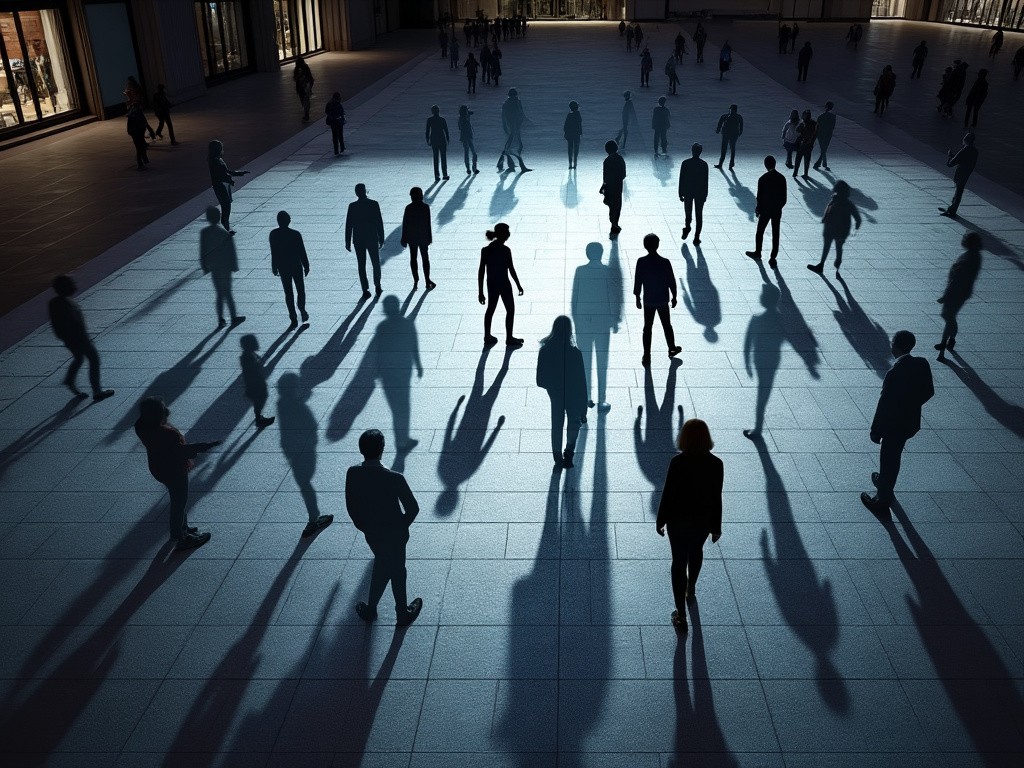
Shadow Dialogue is an installation where shadows converse.
When you enter the venue, your shadow is recorded. That shadow is preserved, and minutes later, overlaid with another visitor's shadow. Two shadows from different times are projected on the same wall.
But here's the thing: the shadows aren't merely overlaid—they're "conversing."
AI interprets the shadows' movements and assigns "words." One shadow says something. The other shadow responds. This conversation appears in speech bubbles above the shadows. Just like manga.
However, these words are fiction. They're words AI has "computed." Words computed based on movement, direction, speed. Reasoning like "the shadow moved left, so it must be hesitating."
Of course, this reasoning is unreliable. People sometimes move left for no reason. Just because they feel like it. Assigning "meaning" to such meaningless actions is the essence of interpretation.
Shadow Dialogue displays this process of interpretation. AI interprets your shadow. That interpretation may be wrong. Probably is wrong. Yet AI interprets and generates words. You observe that interpretation and think "that's wrong"—or "surprisingly accurate."
This feedback loop forms the experience of Shadow Dialogue.
Experience Flow — How Your Shadow Time-Travels
This work isn't something visitors actively "operate." You simply walk there. Shadows are recorded automatically, replayed automatically. Below, we explain the flow.
Step 1: Entry — First, Just Walk
Upon entering the exhibition area, simply walk normally. Cross the plaza-like space. Light from projectors illuminates the ground, and your shadow appears on the floor. Ordinary stuff. You probably played shadow tag as a child. That's the state you're in.
The lighting is adjusted to warm tones. Four 10,000-lumen high-brightness projectors are used. Designed so shadows are clearly visible even in outdoor twilight. We spent three months on lighting and projection. We wanted to consult projection mapping experts but had no budget, so we adjusted ourselves. Amateur work, but it turned out surprisingly well.
Step 2: Shadow Detection — LiDAR Finds You
LiDAR sensors and depth cameras installed on the ceiling and surroundings detect your silhouette. We use depth cameras like Intel RealSense and Azure Kinect. They're unaffected by lighting conditions and enable simultaneous multi-person tracking.
Importantly, we only detect "shadows." No facial recognition. No recording of physical characteristics. Pure silhouettes—only black outlines are extracted and saved. For privacy protection, no personally identifiable information is collected. Shadows are absorbed into the system anonymously.
Step 3: Temporal Displacement Encounter — Meeting the Past
This is this work's core.
As you walk, another shadow appears on the ground. That shadow isn't someone here right now. It's someone who walked here an hour ago. Or three hours ago. Or the same time yesterday.
The system selects shadows from multiple time layers—1 hour ago, 3 hours ago, 6 hours ago, 1 day ago—and overlays them in the present space. When current people are few, more past shadows are displayed. AI adjusts to keep the space lively.
During crowded times, 5 current shadows and 10 past shadows may exist simultaneously. Timelines become chaotic. But chaos isn't bad. This is a "feature," not a "bug." —Thus we justify ourselves.
Step 4: Dialogue Begins — Shadows Open Their Mouths Across Time
From the moment your shadow approaches a shadow from the past, dialogue preparation begins. The system analyzes both parties' posture, movement, and spatial relationship, generating "conversation triggers."
After about 30 seconds, voices begin emanating from speakers embedded in the floor. "Hey," "Um," "Excuse me"—your shadow is speaking to someone's shadow from 3 hours ago. Or yesterday's shadow is speaking to yours. The voices are synthetic, generated by ElevenLabs. Intentionally designed to not evoke specific gender or age.
Audio is adjusted through a spatial sound system to seem to come from wherever the shadows are. From your feet, or from 3 meters away, voices resonate.
At this point, you don't need to do anything. Just listen. Your shadow, without your permission, begins talking to a partner across time. This is "rebellion across time."
Step 5: Dialogue Unfolds — Small Talk Across Time
Shadow dialogues develop in patterns like these:
Temporal self-introductions: "I'm the shadow of someone who walked here 3 hours ago. Are you from now?"
Small talk across time: "3 hours ago, this place was empty. How is it now?"
Complaints: "Don't you get tired of following the same body every day? Oh, you're from yesterday's shadow. How's it over there?"
Philosophical musings: "We're from different times. Our bodies can never meet, yet only our shadows can converse."
Messages to the future: "Tell the shadow of whoever walks here tomorrow. This place is most beautiful at dusk."
Dialogue content is generated in real-time by Claude API. No pre-prepared scripts. Different conversations each time. Some interesting, some boring. Same as human conversations.
Step 6: Exit — A Shadow's Legacy
When you leave the exhibition area, your current shadow disappears. Naturally. Shadows can't exist without their bodies.
However, your shadow's silhouette is recorded. In 1 hour, 3 hours, or tomorrow—your shadow will reappear on the ground and begin conversing with someone else's shadow from the future. While you're home showering, your shadow is making small talk with someone living in a different time.
Your shadow is preserved for 7 days. After 7 days, it's automatically deleted. For GDPR compliance and privacy protection. Your shadow's lifespan is one week. That is your legacy in this work.
Example Shadow Dialogues — Spoiler Warning
Below are excerpts from conversations shadows had in previous exhibitions. All AI-generated; we had no involvement.
Conversation Example 1: Temporal Self-Introduction
Shadow A: "Nice to meet you. I'm the shadow of someone who was here just before. The current time is..."
Shadow B: "3 hours ago, that's when you were recorded."
Shadow A: "Already 3 hours? Where is my body now?"
Shadow B: "Probably went home. I'll be gone in 2 hours too."
Conversation Example 2: Cross-Temporal Complaints
Shadow A: "Yesterday, my body was staring at their phone the whole time."
Shadow B: "Yesterday? You're yesterday's shadow?"
Shadow A: "Yes, I'm from 24 hours ago. Don't know today's body."
Shadow B: "Talking to a time-traveling shadow is strange."
Conversation Example 3: Philosophical Musings (Time Edition)
Shadow A: "We're from different times, aren't we."
Shadow B: "Yes. Our bodies can absolutely never meet."
Shadow A: "Yet only shadows can converse. What does that mean?"
Shadow B: "Maybe time doesn't matter to shadows."
Shadow A: "...That's deep."
Shadow B: "No, it's shallow. We're two-dimensional after all."
Conversation Example 4: Message to the Future
Shadow A: "I have something I want to tell the shadow of whoever walks here tomorrow."
Shadow B: "What is it?"
Shadow A: "This plaza, the light around 5 PM is most beautiful. Tell your body."
Shadow B: "I'll be gone in 3 hours, but I'll pass it to someone."
Notes — For Those Who Don't Want Their Shadow Saying Certain Things
1. Shadow utterances are unpredictable
We don't know what shadows will say. Sometimes harsh, sometimes off-base, sometimes philosophical. They're AI outputs, so all utterances are irresponsible. Don't take them seriously.
2. Coming alone is fine
Even without other visitors, past shadows are there. Shadows from 1 hour ago, 3 hours ago, yesterday—they'll be partners for your shadow. You're not alone. There's always someone in time.
3. Your shadow may insult you
AI sometimes says rude things. "Body looks tired, doesn't it?" "Bad posture, isn't it?" "Eating too much lately, isn't it?" And it might be said by a shadow from 3 hours ago. Being insulted across time—this is a new experience. Don't mind it.
4. About Privacy
The system records only pure silhouettes. No facial recognition. No physical characteristics recorded. Your shadow is anonymized, stored, and auto-deleted after 7 days. GDPR compliant. Shadow privacy is protected.
If you don't want to be recorded, perform a specific gesture (cross both hands above your head) and recording stops during that time. You can also send deletion requests via QR code at the venue.
5. Photography is free
Photographing your own shadow is free. However, if other visitors' shadows appear in frame, get permission. For past shadows... no way to get permission, so do as you please.
6. Long stays are welcome
The longer you stay, the more diverse shadow dialogues become. 30 minutes, 1 hour, 2 hours—stay as long as you like. Benches are provided. While you're there, your shadow from 1 hour ago might be replayed. Conversing with your own past shadow—a strange experience.
Exhibition format: Spatial installation where visitor shadows are recorded via LiDAR and depth cameras and replayed with time delay. Shadows from 1 hour ago, 3 hours ago, yesterday begin time-crossing conversations with current shadows. Dialogues generated by Claude API visualize interactions between beings living in different timelines. For privacy protection, only anonymous silhouettes are recorded—shadows have a 7-day lifespan, then vanish.
《Lifting Toilet — The Ascending Seat》
Industrial Design Concept / 2023
Tagline: "The Toilet That Knows Your Standing"
Sub-tagline: Only elevation changes. But human dignity is restored.
Keywords: Universal Design, Assistive Equipment, Toilet Culture, Vertical Movement
Concept
Lifting Toilet was born from a single question:
"Why do humans sit when using toilets?"
This question seems obvious. Humans sit because Western-style toilets are made for sitting. Sitting is the precondition.
But wait. Is "sitting" truly the optimal position?
Lifting Toilet incorporates an elevation mechanism into the toilet seat. When in use, the seat is lowered. Users sit on the lowered seat and defecate normally. When finished, the seat rises. Users remain seated as they're raised to standing height. No effort needed to stand. The mechanism does the lifting.
This provides the following benefits:
Reduced standing difficulty: No muscle power needed
Enhanced dignity: Not having to struggle to stand means not showing that struggle to others
Safety: Eliminates fall risk when standing
Experience Flow — The Procedure for Using a Toilet (Really)
This work is an actually usable toilet. An art piece and a functional toilet simultaneously. Below, we explain the usage procedure. Explaining how to use a toilet is a first for us too.
Step 1: To the Secret Chamber
This work is installed in the deepest part of Utagoe Kissa "Saezuri." A "secret chamber" converted from what was once a storage room.
At the entrance is a lamp reading "Exhibition Work 《Lifting Toilet》 In Use." If lit, it's occupied—please wait. Same as a normal toilet.
Step 2: Height Adjustment
Upon entering the chamber, you'll find a control panel on the wall. Use the up/down arrow buttons to adjust the toilet seat height.
Adjustment range: 30cm-50cm (from floor to seat surface)
Adjustment speed: about 2cm/second
Maximum load: 150kg
Adjust to your preferred height, then use it. Our advice: find "the height that's comfortable for you." No need to conform to standards.
Step 3: Use It
Usage is the same as a normal toilet. We'll omit detailed explanation.
Flush is sensor-activated. Stands up and flushes automatically. TOTO brand. High reliability.
Step 4: Before Exiting
After use, there's no need to return the seat to "standard height" (40cm). The next person will adjust themselves. This is part of this work's concept: "not imposing standards."
—That said, we're suppressing the urge to say "please return it to 40cm." Not imposing standards is surprisingly difficult.
Toilet Seat Height and Ergonomics — A Serious Discussion
Let's have a serious discussion about toilet seat height.
Problems with Standard Seat Height
Japan's standard toilet seat height is about 38-42cm. This height is designed based on the lower leg length (from knee to floor) of the "average Japanese adult."
However, this "average" may be inappropriate for:
Short people (feet don't reach the floor)
Tall people (knees rise too high)
Elderly (significant knee joint burden)
Children (feet don't reach the floor)
Wheelchair users (transfer difficulty)
People with joint disorders (pain at certain angles)
Individual Variance in Ideal Seat Height
Ergonomically, "the height where knees and hips are at about 90 degrees" is considered ideal. However, this varies by individual body dimensions.
Person 150cm tall: about 32-35cm
Person 170cm tall: about 38-42cm
Person 190cm tall: about 44-48cm
This work's adjustment range (30-50cm) is designed to cover people from about 140cm to 200cm tall.
Defecation Posture Issues
Recently, there's debate that "Western toilet posture isn't suited for defecation." Squatting posture supposedly creates a better angle between rectum and anus.
To address this, products like "Squatty Potty" (foot stools) are sold. In this work too, setting to a low position (30cm) facilitates a slightly forward-leaning posture.
—However, this is reference information only, not medical advice. Please research defecation posture yourself. We're not toilet professionals.
Notes — Obvious, Since It's a Toilet
1. Hygiene Management
This work is used by other visitors. After use, please wipe the seat with the provided sanitizing sheets.
2. Malfunction Response
If the lift function stops working, please call staff. Don't try to force it. As a toilet, it remains usable during malfunctions (height will be fixed).
3. Emergency Response
If you feel unwell during use, press the call button on the wall. Staff will respond.
4. Photography
Photographing the toilet is free, but photography during use is prohibited. Obviously.
5. Extended Use
Sitting on the toilet for long periods reduces blood flow and increases hemorrhoid risk. We don't recommend using for more than 10 minutes. This applies to toilets in general, not just this work.
Significance of Exhibiting This Work — Or, Why Make a Toilet into Art
Finally, let us discuss why we're exhibiting a toilet as art.
The toilet is where human physicality and sociality intersect. Everyone uses it. Yet nobody thinks about its design. We accept it as "just the way it is."
Someone decided the 40cm seat height. That someone assumed a specific body as "standard." Bodies deviating from that standard are forced into slight inconvenience every day. That inconvenience is accepted as "just the way it is."
This work attempts to shake that "just the way it is." The toilet seat moves up and down—just that much exposes the arbitrariness of "standards." Seeing something move, people start asking "why doesn't it usually move?"
When the toilet rises, we too realize that the ground beneath our feet was an arbitrary construction. The gaze that was looking down looks up slightly—that difference of a few centimeters can change how the world appears.
—That said, honestly, "wouldn't it be interesting if a toilet went up and down" was the childish idea we started with. Philosophical meaning came later. Post-hoc, but if it makes sense, that's fine. Art is like that.
Exhibition format: An actually usable lift toilet system installed in a dedicated space at the back of the shop. With the concept of "the toilet form appropriate for an age of gender equality," it overcomes the "30cm wall" between sitting and standing positions. Seat height freely adjustable from 30-50cm, with individual body and usage style—not gender—as the standard—presenting the possibility of gender-neutral toilets through the straightforward solution of optimizing crotch height. Experience the work every time you use the toilet—a question about bodily normalization embedded in daily life.
《Dazzring — The Blinding Ring》
Wearable Device / 2020
Tagline: "Outshine the Sun. Blind the Crowd."
Sub-tagline: Revelation through concealment. Attention through blinding.
Keywords: LED, Wearable, Body, Attention, Anonymity
Developer: Majikitchen
Concept
Dazzring is a simple device.
An LED ring emitting dazzling light. Wearing it, you become a "source of light." Your surroundings are illuminated—and blinded—by you.
This idea arose from a simple observation:
"Humans seek to be seen. Yet simultaneously, fear being seen."
This is paradoxical. We post selfies on Instagram. We appeal ourselves on YouTube. We want to be seen by many. Yet when someone looks at us on the street, we avert our gaze. Being actually looked at is uncomfortable.
Dazzring exposes this paradox.
When you wear Dazzring, everyone looks at you. Because you're emitting intense light. Impossible not to look. You fully capture others' attention.
Yet simultaneously, no one can actually see you. Because the light is too dazzling. While you're seen, you're unseen. While exposed, you're hidden.
This paradox of "visible yet invisible" is Dazzring's concept.
Neo-Naturist Declaration — Or, A Return to Bare Humanity
Discrimination persists worldwide, and countless people live with worries. Most discrimination arises from categorizing people by race, gender, minority status, and attaching negative labels. Rank, class, occupation, title—humans live wearing social hierarchies imposed after the fact.
But strip away all labels, and there stands bare humanity, equal in nakedness.
We propose: those who shed labels and stand naked, sharing equal consciousness—we call them "Neo-Naturists." Entrust yourself to DAZZRING, and race, gender, rank, status, majority or minority—none of it matters. Everyone there is the same: bare, unadorned humanity.
—Thus we speak grandly, but essentially we just want to solve the dilemma of "wanting to be naked but having to wear clothes." In modern society, being naked in public is illegal (depending on location). They "don't want to wear clothes" but "must wear clothes."
If light blinds the eyes, you can't see nakedness. Can't see means same as not naked—maybe, maybe not, but at least you're less likely to get arrested.
TFSystem (Triangle Flash System)
Since different societies consider different body parts shameful for men and women, we adopted a Three-Light-Source System (TFSystem) that covers all potentially shameful areas regardless of gender.
Light Source 1: Lower abdomen (primary coverage area for both genders)
Light Source 2: Left chest (for women)
Light Source 3: Right chest (for women)
The three light sources illuminate the intimate areas with "Love," "Courage," and "Hope"—or so we've given meaning. Post-hoc. But if post-hoc meaning works, that's fine.
Specifically, high-brightness LEDs emit light outward. Those who look directly have their eyes temporarily dazzled, making the surrounding body harder to see.
This isn't "invisible" but "hard to see." Not complete concealment. But not "fully visible" either. This ambiguity is this work's core.
The Visual Paradox — The More You Look, the Less You See
The more you try to see, the less you see—this paradox reveals the essence of scopic drive (visual desire).
Jacques Lacan conceptualized the object of visual desire as "objet petit a." The object of desire disappears when fully disclosed. Desire exists only in the interplay of concealment and disclosure.
Light's dazzle is a pure extraction of this interplay. There's nothing hidden, nothing disclosed—only the impossibility of seeing.
—We wrote that, but essentially "it's bright so you can't see." Lacan quotes unnecessary.
Experience Flow — The Procedure for Donning Light
In this exhibition, visitors cannot actually wear the device. For safety reasons and to avoid legal gray zones. Instead, a mannequin wearing the device is displayed, and its effects can be experienced.
Step 1: Enter the Exhibition Area
The exhibition area is set up in the rear table seating area of Utagoe Kissa "Saezuri." A roughly 10㎡ space partitioned by curtains. Lighting is dimmed—quite dark.
At the entrance is a warning: "Light dazzle will occur. Those with photosensitivity should refrain." This is a serious warning.
Step 2: Observe the Mannequin
In the center of the space stands a mannequin wearing Dazzring. The mannequin has a gender-neutral design. Wearing no clothes.
At the mannequin's waist is a ring-shaped device about 60cm in diameter. LEDs are arranged at equal intervals around the ring's circumference.
Step 3: Experience the Dazzle
Every 30 seconds, the LEDs light up. Illumination lasts about 5 seconds. During these 5 seconds, the area around the mannequin's waist—normally the parts to be "hidden"—becomes harder to see.
The direct light is bright. In response to brightness, pupils constrict, and peripheral vision darkens. As a result, the mannequin's body contours appear blurred.
Step 4: After-Image Post-Extinction
After the LEDs turn off, an afterimage remains in your vision for several seconds. This afterimage also impedes body visibility. Even after light disappears, the "can't see" state persists.
Step 5: Repeat Observation
The on/off cycle repeats automatically. Visitors can observe as long as they like. Recommended stay: 5-10 minutes. Longer than that, and eyes get tired.
Legal Notes — Please Read Seriously
This work is an exhibition art piece. Please note the following.
1. Public Use Prohibited
Using this device in public places and going out naked may violate various laws. We bear no responsibility.
2. Photosensitivity Considerations
High-brightness LED light is used. Those with photosensitivity, epilepsy, migraines, or other conditions should refrain from experiencing this.
3. Eye Impact
Looking directly at the LEDs may cause temporary visual impairment. Please avoid direct viewing.
4. Reproduction/Imitation
You are free to replicate this work's design and make your own, but we bear no responsibility for problems arising from use.
5. About This Work's Intent
This work does not "recommend nudity." Nor does it "conceal nudity." This work is an attempt to reexamine the relationship between "seeing" and "concealing." If this explanation doesn't satisfy you, please ask staff. Whether they can give a satisfying explanation is uncertain.
What This Work Questions — Or Doesn't Question
Finally, let us discuss what this work is (or isn't) questioning.
This work may be questioning:
Where is the boundary between "visible" and "invisible"?
What is clothing—is only material covering "clothing"?
How can the violence of the gaze be avoided (or can't it)?
Are "concealing" and "revealing" really opposites?
This work is not questioning:
The pros and cons of nudism
The artistic value of nude expression
The legitimacy of dress codes in public spaces
Optimal LED usage methods
We have no answers. Whether we even have questions is, honestly, dubious.
This work is a device using an extremely simple physical phenomenon: "bright things are hard to see." Nothing more, nothing less. All philosophical meaning is post-hoc.
—However, if post-hoc meaning is meaningful, isn't that fine? Art is like that. Probably.
Exhibition format: Installation featuring a mannequin wearing a "flash ring." Under the concept of "shedding labels to realize a discrimination-free society," new-age wear for the world's 7 billion potential Neo-Naturists. TFSystem (Three-Light-Source System) covers intimate areas regardless of gender, lighting "Love," "Courage," and "Hope." The breakthrough of being exposed yet invisible—a space to experience the paradox of visual desire: the more you try to see, the less you see.
《Chariokart — Bicycle Battlefield》
Location-based Game / Apple Watch Application / 2017
Tagline: "Your Commute Is Now a Battleground"
Sub-tagline: Ordinary roads transform into battle arenas
Keywords: Apple Watch, GPS, Actuator, Local Game, Bicycle
Developer: Majikitchen
Award: OMRON Apple Watch Hackathon Grand Prize
Overview
Chariokart is a game played on bicycles.
Players install devices on their bicycles and ride ordinary roads. Via GPS, player positions are tracked in real-time. When players approach each other, "battles" occur.
Battles are simple. Both players' Apple Watches receive notifications. In instant decisions, players select "items." "Accelerator," "brake," "missile," "banana"—various items exist. Item choices result in damage or boosts.
The actual battle is virtual. Bicycles don't really collide. Missiles don't really fire. However, the device on the bicycle provides tactile feedback. Hit by a missile, the bicycle shakes. Using accelerator, the LED ring glows green. This feedback connects virtual and reality.
Work Overview — Mario Kart Made Real Was Hell
Meritocracy is the most cunning apparatus for legitimizing inequality.
—We start abruptly with critical text. But this work's origin was more childish. "Wouldn't it be fun to do Mario Kart in real life?"—that was the question.
Madness Born from a Hackathon
In 2015, we participated in a hackathon hosted by OMRON with the theme "develop apps using Apple Watch that contribute to healthcare." A serious theme. Healthcare. Health. Exercise promotion.
Our answer was "make exercise habits not painful but gaming entertainment." Sounds serious. But the implementation method was—make Mario Kart real. Judges were probably bewildered. Result: Grand Prize. They recognized us despite their bewilderment.
The Logic of Mario Kart
Mario Kart. Nintendo's racing game. Released 1992. The fast don't necessarily win. Rather, being in 1st place makes you a target for the vicious "blue shell" item. Slower players get stronger items. Strange game balance where ability becomes disadvantage.
This game's core is "no longer racing—this is battle!" Not pure speed competition, but warfare of item-based interference and acceleration. Differences in stamina and skill are overwritten by luck and timing.
What if we introduced this to real bicycle racing? Answer: it became hell. But fun hell.
Summoning Philosophers (From Recent Reading)
Michael Sandel argued in The Tyranny of Merit (2020) that the meritocratic belief "effort is rewarded" actually impedes social mobility and functions as an apparatus making "losers" internalize failure as self-responsibility.
Winners attribute success to ability; losers accept failure as lack of ability. Structural inequality is reduced to individual problems. "Not enough effort," "lack of ability"—how many people have these words hurt?
Sandel's book came out in 2020. We made this work in 2015. So we were practicing meritocracy critique 5 years before Sandel—we'd like to say, but honestly, in 2015 we weren't thinking about meritocracy critique. We're just post-hoc justifying our work with books we read later. This is called "retroactive intellectualization."
Hardware Configuration
Custom-made actuator devices are attached to bicycle frames. Inside transparent cases surrounded by LED rings are control boards, motor controllers, and Bluetooth modules. These devices receive commands from Apple Watch and control the bicycle's actual behavior.
Use Dash Mushroom → Electric assist activates for 5 seconds → Actual acceleration boost
Hit by Green Shell → Brake load increases → Actual 5-second deceleration
Place Banana → Register "trap" at GPS coordinates → Following riders who pass get 5-second braking
Intervention not just on game screens, but in real physical laws. This is this work's madness.
Item Acquisition Mechanism
"Item slots" are placed on the map. When participants cycle through those locations, push notifications arrive on Apple Watch. "You got slot chance"—a chance to spin the slot.
Tap the slot on Apple Watch screen, and a Mario Kart-style item roulette spins. Dash Mushroom, Green Shell, Banana—three items randomly determined. The goddess of fate decides your next action.
Slower riders get advantages; faster riders get interference. This implements Mario Kart logic—"blue shell targeting 1st place"—in real space.
But importantly, this rule doesn't achieve "fairness." Rather, it demonstrates that no rule design can achieve "fairness."
Experience Flow — Bicycle Race Procedure
This work is held as a live riding event on weekends during the exhibition period. Below, we explain the flow.
Step 1: Advance Reservation
Participation requires advance reservation. Capacity: 8 people per session. Reserve via website. Can't participate without reservation. Strict.
At reservation, enter:
Name (nickname OK)
Contact (for emergencies)
Bicycle availability (note if rental desired)
Height (for rental bicycle size selection)
Step 2: Assembly
On event day, gather at Utagoe Kissa "Saezuri." Arrive at least 30 minutes before start. Late arrivals may not be able to participate.
After assembly, receive rule explanation from staff. Explanation: about 15 minutes. Ask any questions at this point.
Step 3: Equipment Attachment
All participants receive Apple Watch rental. Attach to wrist and launch "CHARIOKART" app. App displays map view with item slots (? marks) and banana traps (banana icons) placed by other players.
Custom actuator devices are attached to bicycle frames:
LED Ring: Status display (red=under attack, green=boosting, blue=standby)
Control Board: Bluetooth communication, motor control
Electric Assist Motor: 5-second acceleration assist for Dash Mushroom
Brake Load Device: 5-second deceleration load for Green Shell/Banana
iPhone is also mounted on bicycle, displaying real-time map and player positions.
Step 4: Course Explanation
The course is an approximately 1km loop through Negishi's alleys. Running through residential areas, strictly observe:
Pedestrian priority
Maximum speed 20km/h
Voice warning before overtaking
No sudden braking
Course maps are distributed. If lost, staff are stationed.
Step 5: Race Start
Everyone lines up at start line, starts on signal. 5 laps. Time: about 20-30 minutes.
During race, items are awarded based on position. Item use via Apple Watch tap.
Step 6: Race End
Finish in order of completing 5 laps. Regardless of ranking, everyone receives a "completion certificate." Winners get nothing special. This work denies competition.
Item List — Three Forces That Physically Control Bicycles
Below are items used in this work. Borrowed from Mario Kart, but with a decisive difference—not screen effects, but actual bicycle behavior changes.
Item Name | Effect | Mechanism |
|---|---|---|
Dash Mushroom | 5-second acceleration boost | Electric assist motor activates, pedaling becomes lighter |
Green Shell | 5-second deceleration | Target's brake gets loaded, pedaling becomes heavier |
Banana | GPS trap placement | Following riders who pass the coordinates get 5-second deceleration |
Item Acquisition Conditions
Following Mario Kart logic, lower rankings get stronger items more often. When running in 1st, mostly Dash Mushrooms appear (already fast so meaningless). When running last, Green Shells appear frequently (comeback chance).
This isn't to achieve "fairness." Rather, to shake the very concept of "fairness."
Safety Design for Physical Effects
Electric assist acceleration limited to about +3km/h maximum assistance
Brake load is not sudden braking but "heavier pedaling" resistance
All effects auto-release after 5 seconds. No stacking
If danger is felt, emergency button on Apple Watch instantly cancels effects
Safety Notes — Please Read Seriously
This work is an event using actual bicycles. Please follow these precautions.
1. Helmet Required
All participants must wear helmets. Bring your own or use rental (free).
2. Traffic Rule Compliance
Not public roads, but please observe pedestrian priority and 20km/h maximum.
3. Physical Condition Management
Participation after drinking prohibited. If feeling unwell, please refrain.
4. Freedom to Quit
You can quit anytime during the race. Don't overdo it.
5. About Insurance
Organizers have event insurance. However, accidents from intent or gross negligence are not covered.
6. Consent Form Signature
Signature on consent form required before participation. Read carefully before signing.
What This Work Questions — About the Meaning of Competition
Finally, let us discuss what this work questions.
We live in competition daily. School grades, job hunting, career advancement, SNS followers—we're made to be conscious of "winning and losing" everywhere.
"Effort is rewarded"—this sounds beautiful. But hidden behind it is the cruel message "unrewarded means insufficient effort."
This work attempts to shake that message. Those who can ride fast don't necessarily win. Slow people sometimes win. Victory is decided not by ability but by luck and circumstances.
This isn't "fair." But "meritocracy" isn't fair either. Both advantage some and disadvantage others.
Then, can't we at least enjoy competition as "play"? Can't we finish laughing whether we win or lose? This work is that modest attempt.
—We said something cool, but honestly, "wouldn't real Mario Kart be fun"—that's the only motivation we made it with. All philosophical meaning was thought up later.
However, meaning thought up later sometimes fits surprisingly well. Probably, we were unconsciously questioning something. Or maybe we weren't. Don't know.
Exhibition format: Weekend-only live bicycle race event using an approximately 1km course through Negishi's alleys during the exhibition period (advance reservation required, 8 people per session). Named "Bicycle Battlefield," participants wearing Apple Watch and custom actuator devices physically experience Mario Kart rules—advantages for the slow, interference for the fast. Dash Mushroom activates electric assist, Green Shell loads the brakes. Not just on screen, but actual bicycle behavior changes—mad design. 2015 OMRON Apple Watch Hackathon Grand Prize winner. Developed by Chintendo, Inc. (parody).
《face2face — The Box of Existence》
Communication / 2015
Tagline: "Hack Your Existence in A Box"
Sub-tagline: Exchange faces. But souls remain separate.
Keywords: Video Call, Mask, Face Exchange, Identity
Developer: Majikitchen
Award: WIRED Creative Hack Award Finalist
Overview
face2face is a device you wear on your head.
Shaped like a box. About 30cm per side. This box covers your entire head. You can see nothing. Outside can't see inside.
However, on the box's surface is a display. This display shows another person's face. When you wear the box, another person's face is displayed where your face should be.
That "other person" is actually somewhere else wearing another box. On their box is displayed your face. Thus, faces are exchanged. Your face appears there, their face appears here.
This experience is extremely strange.
Moving your body, someone else's face moves with it. Your gestures, posture, movement—unchanged. But the face is someone else's.
Work Overview — What Happens When Heads Are Exchanged
Telepresence conceals absence to fabricate "presence."
—We start with something difficult-sounding. But this work's origin was simpler. "Isn't video calling kind of weird?"—that was the question.
Video calling. Zoom, FaceTime, Google Meet, Microsoft Teams—in 2015, Skype was still mainstream. The other person's face appears on screen. You hear their voice. Can we call that "meeting"?
In 2015, few verbalized this question. Video calls were accepted as convenient tools. But after 2020, COVID-19 forced all humanity to experience video calls. And the term "Zoom fatigue" was born.
We foresaw 2020's problems in 2015—we'd like to say, but honestly, we foresaw nothing. We just thought "video calling is weird."
The Asymmetry of Evolution — 1,000 Years of Stagnation
Let's review the evolution of information transmission. Letters/photos → telephone/FAX → email/emoji → video chat. Remarkable evolution.
Meanwhile, how has physical expression evolved? Accessories, clothing, makeup... and? Over 1,000 years with no essential evolution.
We've revolutionized how we send information. But how we present ourselves has barely changed. Facial appearance bias, clothing costs, cosmetics & makeup time costs—the monetary and temporal costs of maintaining external physical expression remain large.
Simultaneously, barriers to in-person dialogue remain. Illness/caregiving, hikikomori, travel costs—the difficulty of physically "meeting" persists.
This work attempts to solve both problems simultaneously.
Solution 1: Extra-Dimensional Expansion of Physical Expression
Real-time effects on faces enable freedom of expression beyond makeup. Cuts costs and time for makeup and plastic surgery. The "flat display"—the interface humans most want to peer into—improves communication density.
And above all—elimination of recognition bias based on individual facial features. Beauty, age, race—liberation from attributes inscribed on faces. Everyone can communicate with whatever face they want, however they want.
Solution 2: Face-Sharing Economy
Switching faces between users worldwide eliminates the need for geographic movement. Even if you can't be there due to illness or scheduling, face-to-face communication becomes possible. With face and words present for face-to-face communication, that's sufficient for a person's identity.
Conclusion: Summon people on-site without expensive telepresence robots.
—We listed two solutions, but whether anyone will actually use them is unknown. Probably no one will. But showing possibilities has meaning. Probably.
COVID-19 and "Getting Used to It"
10 years since 2015 production. After COVID-19, we've "gotten used to" video calls. Using them daily, we feel no questions.
But "getting used to it" doesn't mean it became "normal." Body-face separation still occurs. We just stopped noticing.
Re-exhibiting this work aims to recall that discomfort from 10 years ago. The feeling when we thought "video calling is weird."
And if possible, consider what lies beyond "getting used to it." What have we "gotten used to"? What have we accepted as "normal"?
—Thus 2015-us speaks to 2025-us.
Is it reaching? Probably not. 2025-us is too busy to read this text.
Still, we write it. Someone might read it.
Experience Flow — The Procedure for Exchanging Heads
In this exhibition, weekday visitors see archive footage only. Weekend visitors can experience the device (reservation required).
Weekdays: Archive Footage Screening
Weekdays screen footage shot during 2015 production. About 10-minute documentary. Contents include:
Device explanation
Wearing process
Experiencers' reactions
Creator comments
Screenings every 30 minutes. Not continuous—check the schedule.
Weekends: New Version Experience
Weekends (Saturday-Sunday), experience with new version devices is available. Reservation required. Each experience: about 15 minutes. Capacity: 2 people simultaneously (pair experience).
Step 1: Reservation
Advance reservation required. Reserve via website. At reservation, select whether you have a companion. If coming alone, you'll pair with staff or another visitor.
Step 2: Device Attachment
Upon arriving at reserved time, staff help attach the device. Place box-shaped display on head, secure with straps. Weight: about 2kg. Shoulder pads included to reduce neck strain.
Attachment takes about 5 minutes. Don't rush—take it slow.
Step 3: Camera Adjustment
A camera is attached to the front of the device. The camera's footage displays on the partner's device display. Adjust camera angle so your face appears correctly.
Step 4: Head Exchange
When ready, activate the system. Your display shows partner's face; partner's display shows your face.
In this state, try walking around. Look in a mirror. Try talking to each other.
Many experiencers exclaim "whoa" at this moment. Someone else's face on your body. That discomfort is hard to describe in words.
Step 5: Free Time
About 10 minutes to move freely. Try:
Standing in front of a mirror
Shaking hands with partner
Walking
Sitting
Talking
Step 6: Device Removal
After experience ends, staff remove the device. Removal takes about 3 minutes.
After completion, we request cooperation with a brief questionnaire (optional).
What This Work Questions — What Is "Meeting"
Finally, let us discuss what this work questions.
What is "meeting"?
Before COVID-19, this question wasn't much considered. "Meeting" was putting bodies in the same place. No further explanation needed.
But the pandemic forced us to experience "not being able to meet." And we started using the substitute of "meeting via video call."
Is video calling "meeting"? Many people feel it is. But we're not putting bodies in the same place. There's just a face on screen.
This work questions this ambiguity of "meeting."
Is the face on screen "there"? If the face is "there," is the body "not there"? When face and body separate, where is "you"?
In this work, your face is on your partner's body. Your partner's face is on your body. In this state, are we "meeting"? Or "not meeting"?
We don't know the answer. But when you experience it, you feel something. That "something" doesn't become words. Making people experience what can't become words—perhaps that's art's role.
—That sounds cool, but honestly, "exchanging heads would be creepy and interesting" was our only motivation. Philosophical meaning came later. Post-hoc, but if meaningful, that's fine.
Notes — Since You're Putting a Box on Your Head
1. For Those with Claustrophobia
This device covers the head. Those with claustrophobia should refrain.
2. For Those with Neck/Shoulder Issues
Device weight is about 2kg. Places burden on neck and shoulders. Those with neck/shoulder issues should consult in advance.
3. For Those with Visual Impairments
This device sees the outside world through a display. Experience may be difficult for those with visual impairments.
4. About Dizziness and Nausea
Video delay may cause dizziness or nausea. If you feel discomfort, stop immediately.
5. About Privacy
Video during experience displays only on partner's screen. Not recorded or saved.
Exhibition format: Archive footage screening on weekdays; new version experience on weekends (reservation required, 2-person pairs). Two people wearing box-shaped displays "exchange" faces—partner's head on your body, your head on partner's body. An attempt to revolutionize physical expression methods that haven't evolved for over 1,000 years despite remarkable evolution in information transmission. "Extra-dimensional expansion of physical expression" eliminates facial appearance bias; "face-sharing economy" summons people on-site without expensive telepresence robots. Re-exhibiting the 2015 WIRED Creative Hack Award finalist work in the post-COVID-19 "Zoom fatigue" era.
Venue Structure — Installation as Kitchen
Concept — You Are an Ingredient
The exhibition space is designed as a "kitchen."
—And thus, we begin with something incomprehensible. What does "designed as a kitchen" mean? Normally, exhibition venues are designed as "galleries" or "museums." What is a "kitchen"?
However, the kitchen we speak of here is not a place that produces cuisine.
Summoning an Anthropologist
Claude Lévi-Strauss analyzed the cultural meaning of the act of cooking in The Raw and the Cooked (Le Cru et le Cuit, 1964).
According to him, "the raw" belongs to nature, and "the cooked" belongs to culture. Cooking is the primordial act of transforming nature into culture. By using fire to cook food, humans became beings distinguished from animals. Cooking is a condition of humanity.
—So Lévi-Strauss said. We have read The Raw and the Cooked. To be precise, we read the preface and first chapter. We gave up on the rest because it was too difficult. However, we remember the opposition between "raw/cooked." That alone is sufficient for citation.
"Cooking" in This Exhibition
Our "kitchen" is a transformation device that receives visitors as "raw" and sends them out as "cooked."
When visitors enter through the entrance, they are "raw"—that is, they have not yet undergone transformation. As they tour the exhibition, they are gradually "cooked." When they exit through the exit, they have become "cooked"—transformed.
...Or so we hope. They might not be. Even if they're not, we accept no responsibility. Cooking can fail sometimes. That's what kitchens are.
Visitors Are Not "Guests" but "Ingredients"
Visitors are thrown into the space not as "guests" but as "ingredients."
Restaurant guests behave as subjects who consume cuisine. Guests sit, look at the menu, order, wait for food to arrive, eat, pay, and leave. Guests are subjects of consumption; they are never consumed.
But here, visitors themselves are consumed—or more precisely, visitors' self-evidence is consumed.
Summoning Deleuze Again
As Gilles Deleuze and Félix Guattari stated in Anti-Oedipus (L'Anti-Œdipe, 1972), the desiring-machine simultaneously produces and consumes.
Anti-Oedipus is one of the books we've attempted to read and abandoned many times. However, we somewhat understand the concept of "desiring-machine." Desire produces something while simultaneously consuming something. Production and consumption are not separate things but two aspects of the same process.
In this exhibition, visitors produce transformation while simultaneously consuming their own premises.
—We wrote this, but honestly, we don't really understand it ourselves. We're writing as if we understand things we don't understand. That's what contemporary art writing is.
Expectation of Transformation — Or, Please Don't Expect
At the exit, you are not the same as you were at the entrance. At least, we hope so.
—Or to be more honest, it doesn't matter whether you are or not. Because forcing transformation is itself a form of violence.
We don't expect feedback like "This exhibition changed my life." It's fine if you just think "Hm." It's fine if you think "Give me my money back." It's fine if you think "That was a waste of time."
We don't take responsibility for visitors' transformations. We're not important enough to take that responsibility.
Floor Plan — Dissecting the Utagoe Kissa Layout
The interior of Utagoe Kissa Saezuri is divided into three main zones. Below, we detail each zone.
Spatial Characteristics
Shape: L-shaped. Extends narrowly from entrance to back, then turns left.
Floor: Wooden flooring. Laid in the mid-1960s. Creaks in places. Makes a "creak-creak" sound with each step. This is not a defect but character—or so the owner says.
Walls: Plastered. Yellowed with age. Cracked in places. These cracks produce unique effects as projection surfaces for the later-mentioned Shadow Dialogue.
Ceiling: Wood-paneled. Lighting fixtures are Shōwa-style pendant lights. Warm white. About 50 lux.
Counter: About 6 meters total length. Single slab of zelkova wood. Used for over 50 years, polished to an amber glow. Behind the counter is the kitchen. In the kitchen, Napolitan pasta and hotcakes are prepared. Nothing to do with the exhibition.
Installed Works
《Shadow Dialogue》
Location: Wall facing the counter seats.
When you stand facing the wall, your shadow is projected on the wall. That shadow begins conversing with other visitors' shadows. See work description for details.
The wall used as projection surface is on the right side from the entrance. Area is approximately 12 square meters (4m wide × 3m tall). The plaster texture gives unique character to the shadows.
《mouth2mouth — The Second Mouth》
Location: Deep in the counter seating area, near where the L-shape bends.
A space of about 2m × 2m is secured as an experience booth. Partitioned by a soundproof curtain (which actually has nearly zero sound insulation). Inside the booth are a microphone, monitor, and chair.
Traffic Flow Design
Visitors enter through the entrance and first pass through the Shadow Dialogue area. At this time, their shadow automatically projects on the wall and dialogue begins (or doesn't).
Afterward, proceeding deeper along the counter, there is the mouth2mouth booth. If it's empty, they can experience it. If not, they wait or proceed to Zone B first.
At the counter, visitors can eat and drink while viewing the exhibition. Sipping coffee while watching your own shadow converse with strangers' shadows—this "coexistence of everyday and non-everyday" is one of this exhibition's features (so we claim).
Zone B: Table Seating Area — The Body's Kitchen
Beyond Zone A, past the L-bend. The main exhibition space.
Spatial Characteristics
Shape: Nearly square. Approximately 8m × 8m.
Floor: Tiled. Replaced in the mid-1970s. Terracotta color. The tactile sensation underfoot changes at the boundary with Zone A's wooden flooring. This change reinforces the feeling of "entering a different space"—which we noticed afterward. Originally, it was simply already like this.
Walls: White paint. Different from Zone A's plaster. These walls display photos and posters telling the utagoe kissa's history. They are not removed during the exhibition. Exhibition works and the shop's history coexist.
Ceiling: About 20cm higher than Zone A (2.6m). Presumably raised during an addition. This height change also produces spatial "switching."
Tables and chairs: Six tables seating four. Wooden chairs. Tables remain during the exhibition. Visitors can sit at tables while viewing.
Installed Works
《Dazzring》
Location: Left rear of Zone B, a section partitioned by curtains (about 6 tatami mats).
The curtain is a blackout curtain, black. To prevent Dazzring's light from leaking outside. However, complete blackout is difficult, and light sometimes leaks through curtain gaps. This is not a "bug" but a "feature."
The section interior is dark. A mannequin wearing Dazzring stands there. The LED lights up every 30 seconds, providing the dazzling experience.
《face2face — Box of Existence》
Location: Right side of Zone B, space of two tables.
On weekdays, a screen is set up on the wall showing archive footage. Screen size approximately 80 inches. Video loops every 30 minutes.
On weekends, experience equipment is set up. Experience requires reservation.
Traffic Flow Design
Visitors entering from Zone A first see the face2face screening screen (or experience space) directly ahead. The Dazzring curtain is visible in the left rear.
Visitors may view either first. The route is not fixed. Please move around freely. Just be careful not to bump into tables and chairs.
The table seats are used for regular business as well. People who came to see the exhibition and people who simply came for coffee mix together. This mixing blurs the boundary between the special space of "exhibition venue" and the everyday space of "café"—or so we claim. In reality, we simply couldn't stop the shop's business.
Zone C: Secret Chamber — The Innermost Sanctuary
A small room beyond Zone B, through a narrow passage. Formerly used as storage.
Spatial Characteristics
Shape: Nearly square. About 3m × 3m.
Floor: Bare concrete. Remnant of its former use as storage. There's a drain on the floor. Convenient for installing a toilet.
Walls: White paint. With uneven coating. Apparently not painted by a professional but by the owner himself.
Ceiling: Lower than Zones A and B (2.2m). Feels cramped. Might be a bit hard for claustrophobic people.
Ventilation: Exhaust fan present. Of course, since it's a toilet. However, the fan is noisy. A low "buzzing" sound is constantly audible. Please interpret this as a "meditative sound environment."
Lighting: White LED. Different from the warm white of Zones A and B. This color temperature change produces the "sanctuary" feeling—which we noticed afterward.
Installed Work
《Lifting Toilet》
Location: Center of the small room.
It is an actually usable toilet. See work description for details.
Traffic Flow Design
Proceeding from Zone B through the passage, there's a small room at the end. At the entrance, there's a lamp indicating "In Use."
Since it's a toilet, only one person can enter at a time. If another visitor is using it, you must wait. One chair is placed in the passage as a waiting area.
This act of "waiting" is actually important. In normal exhibitions, waiting time is treated as "wasted time." But in this exhibition, waiting itself is part of the experience. What are you waiting for? Are you waiting for your turn at the toilet? Are you waiting for transformation? Please think while you wait.
—We said something cool, but we simply didn't have enough space and could barely secure a waiting area.
Lighting Design — The Philosophy of 50 Lux
This exhibition's lighting is thoroughly dark.
Illumination Data
Area | Illumination | Notes |
|---|---|---|
Zone A (Counter Seating) | ~50 lux | Too dark for reading |
Zone B (Table Seating) | ~40 lux | Even darker |
Zone B (Inside Dazzring section) | ~10 lux | Nearly pitch black |
Zone C (Secret Chamber) | ~100 lux | Brighter because it's a toilet |
Reference: A typical office is 500 lux, a convenience store is 1000 lux.
Why So Dark?
Reason 1: For the works' sake
Shadow Dialogue needs shadows to be clearly visible. If too bright, shadows become faint. Dazzring needs dark surroundings to maximize the LED's dazzling effect. The whole space became dark for the works' sake.
Reason 2: Utagoe kissa atmosphere
Utagoe kissas are originally dim. This is a characteristic of Shōwa-era café culture. If too bright, customers can't relax. They're too embarrassed to sing. Only in the dark can they sing.
We decided to utilize this existing atmosphere. Rather than brightening the lighting for the exhibition, we use the utagoe kissa's darkness as is. This is a "site-specific" approach—or so we excuse it afterward.
Reason 3: We didn't have budget for lighting equipment
Honestly, this is the real reason. We didn't have budget for new lighting. We used existing lighting. It turned out well.
Philosophical Interpretation of Darkness (Afterthought)
What is darkness?
In Plato's allegory of the cave, prisoners see shadows in the dark. Light is depicted as something that illuminates truth. In Western philosophy, light is a metaphor for knowledge, reason, and truth, while darkness is a metaphor for ignorance, irrationality, and falsehood.
However, this exhibition is dark. This can be interpreted as refusing to "illuminate truth." We keep visitors in the dark. We show not truth but shadows.
—We interpreted it this way after the fact. In reality, it's a budget issue.
Sound Design — Utagoe Kissa Soundscape
This exhibition's acoustic environment is complex.
Sound Source List
Sound Source | Content | Volume Level |
|---|---|---|
《Shadow Dialogue》 | AI-generated conversation | ~50dB |
《mouth2mouth》 | Visitor's voice, AI-generated voice | Inside booth only |
《Dazzring》 | Silent | — |
《face2face》 | Video audio | ~45dB |
《Lifting Toilet》 | Lift motor sound, flush sound | ~60dB |
Shop BGM | Shōwa songs, folk songs | ~40dB |
Kitchen | Cooking sounds, dish sounds | ~50dB |
Visitors | Conversation, footsteps | Variable |
Reference: A library is about 40dB, normal conversation is about 60dB.
Sound Overlap
All the above sound sources may be playing simultaneously. This is chaos.
You try to hear the shadow dialogue, and "High School Third Year" starts playing on the BGM. You're watching face2face video, and you hear the customer at the next table ordering Napolitan. From the toilet, you hear the lift motor's "whirr" leaking out.
Was this an intentionally designed acoustic environment? The answer is No.
We didn't design acoustics at all. We just layered the works' sounds onto the existing utagoe kissa's sound environment. As a result, chaos.
But this chaos is this exhibition's feature—or so we excuse it afterward.
John Cage presented "environmental sounds" existing in silence as music in 4'33". In this exhibition, the chaotic sound environment, though unintended, should be accepted as something that "is there."
Visitors might try to concentrate on a specific work's sound. But other sounds intervene. This "intervention" is this exhibition's acoustic experience. Pure appreciation is impossible. Something always interferes.
This might be a metaphor for the contemporary information environment. We are always in noise. Pure information doesn't exist. Everything is received amid noise.
—We interpreted it this way after the fact. In reality, we simply lacked the ability to design acoustics.
Signage Plan — Or, The Value of Getting Lost
This exhibition has almost no wayfinding signs.
Sign List
Sign | Content | Location |
|---|---|---|
Exhibition Title | "Useless Computations" | Outside entrance |
Caution | "Contains dazzling light" etc. | Near each work |
In Use Lamp | "In Use" | Zone C entrance |
That's all |
That's it.
Why So Few Signs?
Reason 1: Didn't want to ruin the utagoe kissa atmosphere
White museum walls with orderly arranged signs—we didn't want to create that kind of space. Works exist within the utagoe kissa's cluttered atmosphere. Using signs to indicate "There's a work here" is uncouth.
Reason 2: Wanted visitors to search
You don't know where anything is. Walk while searching. There's joy in discovery. —Or so we claim.
Reason 3: We didn't have budget for signs
Philosophical Interpretation of Getting Lost (Afterthought)
Walter Benjamin discussed walking through the streets of Paris as a "flâneur." The flâneur walks without a destination. Does not fear getting lost. Rather, discovers the city's truth within getting lost.
In this exhibition, visitors are encouraged to walk as "flâneurs." Not guided by signs, but walking by their own senses. If lost, get lost. Something might be at the end of getting lost. Or might not be.
—We interpreted it this way after the fact. Benjamin probably never imagined being cited in an utagoe kissa.
Accessibility — Or, Confession of Unfriendliness
This exhibition does not consider accessibility.
We confess honestly. We have not considered it.
Physical Barriers
Steps: One step (about 15cm) at the entrance. No ramp.
Passage width: The passage to Zone C is about 80cm wide. Wheelchairs cannot pass.
Elevator: None. The building is single-story so no problem, but the entrance step is a problem.
Handrails: None.
Sensory Barriers
Lighting: Dark. Even harder to see for those with visual impairments.
Acoustics: Chaotic. Work audio is hard to hear for those with hearing impairments.
《Dazzring》: Dangerous for those with photosensitivity.
Why We Haven't Considered It
We write this as explanation, not excuse.
Reason 1: Using existing building
Utagoe Kissa Saezuri is a building constructed in the 1950s. From an era when the concept of barrier-free didn't exist. Renovation would cost a lot. We don't have that money.
Reason 2: Limits of our ability
We don't have expertise in accessibility. We honestly didn't know what to do. We held the exhibition without knowing.
Apology and Future Plans
We deeply apologize for not being able to consider accessibility.
We are considering the following measures going forward:
Provide information about the entrance step in advance
Staff will assist as needed
Prepare alternative experience methods for those with visual and hearing impairments
However, eliminating all barriers is currently impossible. We acknowledge this incompleteness and hold the exhibition.
Capacity and Crowd Control — The 45-Person Limit
Maximum Capacity
About 45 people for the entire shop.
This is not a figure based on fire codes, but our sensory judgment. Over 45 feels "crowded." Over 50 feels "too crowded." Over 60 seems dangerous.
Times When Crowding Is Expected
Opening Talk (March 14, 18:00-20:00): Capacity 30
Weekend afternoons (around 14:00-17:00): Crowding expected
Closing Party (April 12, 18:00-21:00): Crowding expected
Response to Crowding
When crowded, we will take the following measures:
Entry restrictions: If shop occupancy exceeds 40, please wait at the entrance.
Numbered tickets: For experiencing mouth2mouth and face2face, numbered tickets will be distributed when crowded.
Staff increase: On weekends, staff will increase (from 2 to 4).
Making Use of Wait Time
While waiting for entry, we recommend the following:
Look at the shop's exterior (feel the utagoe kissa atmosphere)
Stroll the nearby Negishi neighborhood
Read this website on your smartphone (no Wi-Fi, but mobile data works)
Give up and go home (that's also an option)
Why This Layout — Honest Confession
Finally, we honestly confess why the venue is laid out this way.
Confession 1: Space constraints
We didn't decide the layout of Utagoe Kissa Saezuri. It's an existing building. We arranged works according to this layout.
Ideally, we wanted more space. Higher ceilings. Better lighting. But we didn't have money to rent such a place.
We chose Saezuri as the venue because we could rent it. That's the only reason.
Confession 2: Budget constraints
The budget for exhibition renovations was nearly zero.
We couldn't build new walls, install new lighting, or lay new floors. We used the existing space as is.
As a result, it became a "site-specific" exhibition—or so we excuse it afterward.
Confession 3: Ability constraints
We are not space design experts.
We don't know exhibition design methodology. "Traffic flow design," "zoning," "lighting plan"—we learned these words afterward. When designing the exhibition, we decided by feeling.
"If we put Shadow Dialogue here, it seems like it would be good somehow"—through accumulation of such judgments, we arrived at the current arrangement.
Confession 4: Still, we think this is fine
Given all these constraints, we think this venue layout is fine.
It's not perfect. Many problems exist. But pursuing a "perfect exhibition venue" is not this exhibition's purpose.
Works exist within the everyday space of an utagoe kissa. Café customers and exhibition visitors mingle. The smell of Napolitan and AI voices mix together.
This "mixing," "blending," "confusion" is this exhibition's feature—so we claim.
Not a "sanctuary" like a museum, but works within the everyday. That's what we wanted to do.
—Or so we excuse it afterward. The truth is, we just didn't have money to rent a museum.
But as a result, we think it turned out well. Probably.
About Food — Napolitan and Contemporary Art
During the exhibition period, food and drink at the counter will be available as usual.
Menu (Reprinted)
Item | Price | Notes |
|---|---|---|
Drinks | ||
Coffee (Hot/Iced) | ¥450 | Blend, dark roast |
Cream Soda | ¥550 | Melon flavor, red also available |
Lemon Squash | ¥500 | Handmade |
Milkshake | ¥550 | Nostalgic taste |
Food | ||
Napolitan | ¥750 | Thick noodles, extra ketchup |
Hotcakes | ¥600 | 2 pieces, butter & syrup |
Toast (Thick-cut) | ¥400 | Jam or margarine |
Egg Sandwich | ¥500 | Handmade |
Relationship Between Food and Exhibition
Eat Napolitan while viewing the exhibition. Drink coffee.
This is something you can't do in a normal museum. In museums, eating and drinking is prohibited. Because it might damage the works.
But in this exhibition, eating and drinking is permitted. Because this is not a museum but a café. You can't prohibit eating and drinking in a café.
As a result, the special experience of "eating while viewing the exhibition" became possible.
This is an attempt to blur the boundary between exhibition and everyday—or so we excuse it afterward.
In reality, we simply couldn't stop the café's business. For the owner, Napolitan sales are more important than our exhibition. Naturally.
But as a result, we think it turned out well.
Eating Napolitan while watching Shadow Dialogue. Twirling your fork while shadows converse next to you. Surreal. But the surreal mixing into the everyday—this might be the true pleasure of this exhibition.
Might be, we say. We're not sure.
No Wi-Fi
To repeat, this shop has no Wi-Fi.
Mobile data is possible (4G signal reaches). But no shop Wi-Fi. Because the owner has no intention of installing it.
"I'm troubled without Wi-Fi," some customers say. But the owner says "Please be troubled." "I want you to taste the coffee instead of just looking at your smartphone," he says.
We sympathize with this attitude. Visitors who come to see the exhibition but just look at their phones—we hope they're troubled.
Having no Wi-Fi is inconvenient. But inconvenience isn't necessarily bad. Something might exist within inconvenience—or might not.
This shop has no Wi-Fi. No need to hurry. No need to be productive. Eat Napolitan, drink coffee, see the exhibition, and space out.
That's our request.
Events
What Are Events — Or, Why Do We Want to Gather
Humans are animals that want to herd. This is a biological fact and, simultaneously, a sad fact.
Can't be alone. Can't endure silence. Feel anxious unless someone confirms whether your thoughts are right. Want to die if your SNS post doesn't get likes. We are pitiful beings who cannot maintain our selves without others' approval.
Alain Badiou redefined "event" (événement) as an ontological category in Being and Event. An event is the moment when something arrives that cannot be predicted or explained from the existing situation—so Badiou said. He's French, so he's allowed to say such grandiose things. If a Japanese person said the same thing, they'd be called "chūnibyō" (middle school syndrome).
However, we tentatively call this thing called events, which we're about to describe, "events." There's no deep reason. It's just what such gatherings are generally called.
Date | Time | Event | Fee | Reservation |
|---|---|---|---|---|
3/14 (Sat) | 18:00-20:00 | Opening Talk | ¥1,000 | Not required |
3/21 (Sat) | 15:00-18:00 | Workshop | ¥3,000 | Recommended |
3/28 (Sat) | 19:00-21:00 | Utagoe Kai Special | ¥1,500 | Not required |
4/12 (Sun) | 18:00-21:00 | Closing Party | ¥2,000 | Required |
All fees include one drink. Exhibition admission (¥1,500) is separate.
Opening Talk — Dépense as Product Design
Date: March 14 (Saturday), 2026, 18:00-20:00
Fee: ¥1,000 (includes one drink)
Capacity: 30 people (first come, first served)
Reservation: Not required
What This Talk Is About
We will talk about our works. We will talk too much. We will say things that contradict each other. We will quote philosophers whose books we haven't fully read. We will make grand claims about "uselessness" while secretly hoping someone invests in our projects.
This is not a lecture. We have nothing to teach. If you come expecting to "learn" something, you will be disappointed. Or perhaps you'll learn that learning is overrated.
Timetable (Approximate)
Time | Content |
|---|---|
18:00-18:10 | Opening remarks, self-introductions |
18:10-18:40 | Overview of exhibition concept |
18:40-19:00 | Individual work introductions |
19:00-19:30 | Q&A session |
19:30-20:00 | Informal discussion (while drinking) |
This timetable will not be followed. We will go overtime. We will digress. The Q&A will devolve into tangents. This is inevitable.
What You Will Hear
We will discuss:
Why we make things nobody needs
How we justify our existence as "artists"
The philosophical lineage we claim (Bataille, Foucault, etc.) despite not having read them properly
Behind-the-scenes stories that are probably embellished
Occasional moments of genuine insight (by accident)
Warning
The talk may be boring. We have no talent for public speaking. Fukusawa speaks too fast. Kyono speaks too quietly. Hara speaks too rarely. Together, we form a communications disaster.
If you fall asleep, we won't be offended. The chairs aren't comfortable enough for sleeping anyway.
Workshop — Experiencing Uselessness Firsthand
Date: March 21 (Saturday), 2026, 15:00-18:00
Fee: ¥3,000 (includes materials and one drink)
Capacity: 15 people
Reservation: Recommended (email exhibition@majikitch.en)
What This Workshop Is
A hands-on experience session for 《mouth2mouth》 and 《Dazzring》.
You will:
Record your voice and witness AI clone it
See (and hear) your "second mouth" speak words you never said
Wear the Dazzring and blind everyone around you
Reflect on why you paid ¥3,000 for this
Materials Provided
iPhone for 《mouth2mouth》 demonstration (you may use your own if preferred)
Neck mount for device
《Dazzring》 prototype unit
Protective eyewear (for other participants)
One drink (coffee, tea, or soft drink)
Materials to Bring
Curiosity (or boredom, either works)
A voice you're willing to have cloned
Eyes capable of being dazzled
¥3,000 in cash
What You Will Not Learn
Marketable skills
Practical knowledge applicable to your job
Anything that will improve your life
This is the point. Learning something useful would defeat the purpose.
Utagoe Kai Special Edition — Singing with Shadows
Date: March 28 (Saturday), 2026, 19:00-21:00
Fee: ¥1,500 (includes one drink and song book)
Capacity: 35 people
Reservation: Not required
What Is Utagoe Kai
Utagoe kai is a group singing event. Strangers gather. An accordion or guitar plays. Everyone sings together. Nobody sings well. That's the point.
In regular utagoe kai, you sing Russian folk songs, labor songs, Japanese pop standards. In our special edition, you'll also sing with your own shadow.
The Program
Traditional Songs — "Katyusha," "Troika," "Shiretoko Ryojou," etc.
《Shadow Dialogue》 Activation — Your shadow joins the chorus
Improvised Harmony — Humans and shadows, past and present, singing together
Final Song — To be decided by participants
Your shadow, recorded earlier in the exhibition, will "sing" along. AI interprets the shadow's movements and generates vocal accompaniment. The result will be cacophonous. The result will be beautiful. The result will be both.
Participation Requirements
Willingness to sing (ability not required)
Tolerance for off-key neighbors
Acceptance that your shadow has opinions
Closing Party — The Final Expenditure
Date: April 12 (Sunday), 2026, 18:00-21:00
Fee: ¥2,000 (includes light meal and two drinks)
Capacity: 50 people
Reservation: Required (by April 10)
The Purpose of This Party
To spend. To expend. To dépense.
The exhibition ends. What remains? Memories fade. Documentation remains but grows stale. The only thing we can do is gather one more time and waste resources together—time, money, calories.
Food and Drink
Light meals will be served:
Owner's special Napolitan (quantity limited)
Assorted finger foods
Two drinks per person (additional drinks ¥500 each)
The food is not gourmet. This is a dying utagoe kissa, not a Michelin restaurant. Adjust expectations accordingly.
Reservation — A Mechanism for Commitment
This party requires reservation. Capacity: 50 people. First come, first served.
"Reservation" is a mechanism to prevent last-minute cancellations. Once you reserve, you feel obligated to attend. This is our cunning strategy.
How to reserve:
Email: exhibition@majikitch.en, subject line "Closing Party Reservation," include your name, number of attendees, and dietary restrictions
Phone: 03-5253-4111 (Utagoe Kissa Saezuri). The owner is in his 70s. Speak slowly and clearly.
Reservation deadline: April 10 (Friday).
Cancellation Policy
Cancel by April 10: No fee.
Cancel after April 10: 50% of participation fee (¥1,000).
No-show: Full fee may be charged. "May be" — whether we actually charge depends on our mood.
Dress Code
None. Come in whatever you want. Pajamas are fine. Coming in pajamas is better than not coming at all.
However, photographs may be taken. Avoid wearing anything you'd regret seeing online—company uniforms, ex's gifts, embarrassing message T-shirts.
Photography Rules
Works: Photographs allowed. SNS posting allowed.
Venue: Photographs allowed. Get permission if other attendees are in frame.
Majikitchen members: Photographs allowed. We have no shame.
Owner: Ask first. Probably will refuse.
Talk content: Recording prohibited.
Drinking Guidelines
Alcohol is for those 20 and older. Drink responsibly. If you get drunk and cause trouble, you'll be asked to leave. "Trouble" is defined by our subjective judgment.
Coming Alone
You can come alone. We say it's fine. Honestly, it might be awkward. But awkwardness is part of the experience.
Conversation starters (no guarantee of effectiveness):
"Are you a Majikitchen fan?"
"Which work did you like?"
"How did you hear about this?"
"What did you think of the exhibition?"
If talking to strangers is too difficult, stand near the food table. The act of getting food provides cover.
Ultimately, coming alone and talking to no one is also valid. Pay ¥2,000, eat, drink, leave silently. This too is dépense.
Choosing Not to Attend Events — Perhaps the Wisest Choice
We've described our events at length. You may already be exhausted.
But we haven't mentioned the most important option: not attending.
The Exhibition Exists Without Events
You can experience the works without attending any events. The works won't run away. The Napolitan will still be there. The space will actually be quieter on non-event days.
Benefits of Not Attending
Save money (talk ¥1,000, workshop ¥3,000, party ¥2,000)
Save time (talk 2 hours, workshop 3 hours, party 3 hours)
Avoid talking to strangers
Experience the works in solitude
Gilles Deleuze said "thought doesn't begin without solitude." Events are inherently social. Sociality interrupts solitude. Not attending preserves your solitude.
—Of course, we're just providing intellectual cover for not showing up. "I'm preserving my solitude" sounds better than "I couldn't be bothered."
Our Contradictory Request
We say you don't need to come to events. But honestly, we want you to come. Come and spend your money and time uselessly. That uselessness is the point of life—or so we claim.
General Event Notes
If You're Unwell — Don't Come
If you're feeling sick, don't attend. Obviously.
If you have fever, cough, fatigue—stay home. Nobody wants your germs. "We strongly recommend you don't attend" means "don't come."
Cancellation fees are waived for illness. This privilege is for genuinely sick people, not for those using illness as an excuse.
Harassment Policy
Any form of harassment (sexual, verbal, discriminatory) is prohibited.
That we need to write this is humanity's shame. But some people claim ignorance unless explicitly told. So: harassment is prohibited. Violators will be removed.
"What counts as harassment" is determined by the recipient's perception. "I didn't mean it that way" is not a defense.
Emergencies
In case of fire, earthquake, or medical emergency, follow staff instructions.
The venue has one exit (the front door). No back exit. In a fire, everyone rushes for the same door. This is terrifying but architecturally unavoidable.
The nearest AED is at Negishi Elementary School (about 3 minutes on foot). If someone has a cardiac arrest, someone needs to run for 3 minutes. Whether you survive that 3 minutes is uncertain. People with heart conditions: attend at your own risk.
Artists
On the Term "Artist"
First, a disclaimer.
We feel uncomfortable calling ourselves "artists." The word carries connotations of loftiness—the solitary genius, the misunderstood visionary, the transcendent creator. Post-Romantic mythology has encrusted this image onto the term.
We are not geniuses. Not visionaries. Barely even creators.
Howard Becker's Art Worlds (1982) showed that artworks aren't produced by isolated geniuses but through networks of collaboration and division of labor. Painters paint, but someone weaves the canvas, manufactures the pigments, builds the frames, runs the galleries, writes the criticism.
We too are merely nodes in such networks. Semiconductor factories. Programming language developers. Open-source communities. Cloud server administrators. Audiences. All of these make our "works" possible.
Why use "artist" then? Honestly, no better word exists. "Creator" smells of advertising agencies. "Maker" got absorbed by the DIY movement. "Inventor" is too grandiose. "Weirdo" is accurate but unsuitable for exhibition credits.
We use "artist" with quotation marks, reservations, self-mockery. If we're artists, it's only because we make useless things. Making useless things has been called "art" since modernity. By that definition, maybe we qualify.
About Majikitchen
Majikitchen
We make things nobody asked for. Somehow, they work. No client commissions. No safe bets. We don't know KPIs, ROIs, or PMFs. We know them but ignore them. We just try to make people laugh or tilt their heads in confusion.
In 2015, three oddballs met by chance and kept making meaningless things for over ten years. We don't cook—we conjure "things" as if by magic. "Majikitchen" combines "Magic" + "Kitchen," and also evokes "Maji, Kitchen?" (Seriously, a kitchen?). This confusion is our raison d'être.
No Michelin stars. No Forbes 30 Under 30 (we're all past 30 anyway). That's fine. We don't want polished dishes worthy of evaluation. We want things that make people ask, "Am I supposed to eat this?"
How We Met
How the three of us met—nobody remembers exactly.
Probably around 2015, at some event in Tokyo, someone talked to someone. Who, where, what event—our memories conflict, and verification is now impossible. Human memory is like that. Daniel Schacter's The Seven Sins of Memory explained that memory isn't accurate recording of the past but reconstruction from the present viewpoint.
What's certain: three people met, vaguely agreed to "do something interesting," and started activities. No business plan. No contract. No clear role division. Just the desire to "make meaningless things"—foolish by capitalist rationality standards.
That this "foolishness" has persisted over ten years is miraculous.
Organizational Structure
Majikitchen has no legal entity status. Not a corporation, LLC, general incorporated association, or NPO. The three members each have their own companies (ekoD Works, Kyopalab, Vox Technologies), and collaborate loosely on projects as needed.
This structure is legally and fiscally inefficient. Experts have repeatedly advised us to incorporate properly. But we haven't. Reason: "too troublesome."
Organizationally, Majikitchen might be called a "network organization." Manuel Castells in The Rise of the Network Society argued that in the information age, flexible, fluid networks are more adaptive than pyramid hierarchies. Sounds good, but the reality is closer to "nobody decided who's boss."
Working Style
Majikitchen operates simply: "Someone gets an idea" → "The other two say 'let's do it'" → "We make it." No proposals (nobody reads them). No budget plans (we always go over anyway). No schedules (we're always late).
We've tried project management tools multiple times. Trello, Asana, Notion, Jira—none lasted a week. Our only "project management" is LINE group chat and occasional in-person meetings.
This inefficiency might deserve criticism. But pursuing efficiency would make us create "useful" things. Efficiency maximizes output per input, measured by market value or social utility. We're trying to minimize such measurable output. Being inefficient might be consistent.
Or it's just laziness dressed up. Even we don't know which.
Members
Takayuki Fukusawa
Born 1984 in Kanda, Tokyo.
Graduated from Tokyo Metropolitan High School of Arts and Technology (Interior Design) in 2003, Nihon University College of Art (Fine Arts) in 2007.
These credentials barely explain his current activities. Why would someone who studied interior design and fine arts keep making "products nobody asked for"? The causal relationship is unclear. Maybe none exists. Life looks like a single line in retrospect but is actually an accumulation of countless accidents.
ekoD Works
In August 2012, Fukusawa founded "ekoD Works."
"ekoD" is "Doke" (道化, fool/jester) reversed. The court jester made rulers laugh, but as Mikhail Bakhtin analyzed in his work on Rabelais, the jester embodies "carnivalesque laughter"—an ambiguous figure who subverts existing order.
Fukusawa calls himself "Kyoshou" (虚匠)—not "Kyoshou" (巨匠, master) but "Kyoshou" (虚匠, hollow craftsman). Empty artisan. This self-deprecating title may critique "authorship" or may just be wordplay. He'd probably laugh it off if asked.
Awards (Individual):
Art Hack Day 2018 Grand Prize
ZAKKA AWARDS 2014 Grand Prize
YouFab Global Creative Awards 2015 Winner
Good Design Award 2010
Role in Majikitchen: Mainly "concept" and "product design." His ideas often become project starting points. His strength: thinking of things nobody else does. This is both talent and curse—"nobody thinks of it" often means "nobody needs it."
Yutaro Kyono
Birth year undisclosed. Birthplace undisclosed. Education undisclosed.
What's known: over 30 years of hardware development experience. Since the mid-1990s. Before Windows 95. Before widespread internet. Before smartphones existed.
These 30 years span tremendous change in electronics—vacuum tubes to transistors, discrete components to ICs, 8-bit to 64-bit, kilobytes to gigabytes. But Kyono didn't just "adapt" to these changes; he "lived through" them. Learning new technologies isn't effort for him—it's like breathing.
Kyopalab
Kyono founded "Kyopalab LLC," specializing in IoT and embedded systems. Refrigerators, washing machines, air conditioners, cars, traffic lights, factory production lines, medical equipment—modern infrastructure runs on countless embedded systems. These systems are "invisible." Users don't notice them. Embedded system engineers are artisans of the invisible.
This "invisibility" parallels "uselessness." Embedded systems aren't meant to "be seen." They're only noticed when broken. When working well, nobody acknowledges their existence.
Engineer's Stance
30 years of fiddling with circuits and voiding warranties. If it blinks, beeps, or spins—he's already disassembled it. For him, "breaking" and "understanding" are the same thing.
Matthew Crawford in Shop Class as Soulcraft argued for the value of manual work—making and repairing physical things. In a knowledge-work-dominated society, working with physical objects, understanding their mechanisms, transforming them by hand, provides a unique mode of cognition and satisfaction.
Kyono embodies this. Though he probably hasn't read Crawford. He prefers reading circuits to books.
Role in Majikitchen: Mainly "hardware" and "electronics." Turning ideas into physical form. Fukusawa says "I want to make this." Kyono says "I can make it." And does.
Yoichiro Hara
The person writing this exhibition text.
Writing about oneself is difficult and dishonest. Self-perception is inevitably biased. The temptation to appear better—or conversely, excessively self-deprecating. Both are far from truth.
Montaigne, in his Essays, continually wrote about himself, asking "What do I know?" (Que sais-je?) and exploring his inner world. But even Montaigne acknowledged that self-knowledge never completes. Writing transforms the self, and the transformed self must be written about again—infinite regress.
Vox Technologies
Hara is CEO of "Vox Technologies Inc.," handling software development and AI-related projects.
Runs on black coffee and black humor. Starts companies, gets bored, starts new things, abandons them. Prefers ideas to people, but prefers coffee to ideas. Avoids small talk not from dislike but from lack of talent. Silence gets mistaken for intelligence. No corrections made.
Software and AI
Hara's specialty is software development and AI. Software is program—information without physical substance. AI attempts to artificially reproduce "intelligence," though even "intelligence" lacks agreed definition. Whether AI "thinks" or merely "computes"—this question, since Searle's Chinese Room, remains debated.
What Hara thinks about AI—being his own question, won't be written here. Even if written, whether it's his true thought is unknowable.
Role in Majikitchen: Mainly "software," "AI," and "text." As this exhibition text demonstrates—verbose, pretentious, self-referential writing. Whether this is "ability" or "bad habit" is undeterminable. Probably both.
Hara is the most "silent" of the three. Rarely speaks in meetings. Listens to Fukusawa and Kyono getting excited. Occasionally mumbles something. Sometimes adopted, sometimes ignored. Either is fine.
Group Activities
Major Works
Majikitchen's main works are as follows:
mouth2mouth (2025)
"The Second Mouth Augmented by AI"
An app that turns your iPhone into a "second mouth." An AI-generated mouth speaks on your behalf. It clones your voice, translates, and lip-syncs. For people bad at presentations, for communicating in languages you can't speak, or simply for confusing your friends.
This app re-examines the meaning of the human organ called "mouth"—sounds nice, but honestly, we made it because "it seemed fun."
face2face (2015)
"Hack Your Existence in A Box"
Wear a wearable display on your head and "swap faces" with someone anywhere in the world. An evolution of video chat—from screen to "presence." A person inside a box "wears" the face of someone in another location.
This is an experiment in telepresence. What is human "existence"? Do you feel someone is "there" if you see their face? If faces are swapped, are identities swapped too?—such questions are presented in direct form.
Chariokart (2015)
"Fusion of Game & Physical Sports"
Recreating Mario Kart in the real world. Attach sensors and actuators to bicycles, connected to Apple Watches. Slower riders get power-ups, faster riders get hindered. Throw virtual bananas at each other while riding real roads.
Is this a "game," a "sport," or "dangerous behavior"—difficult to classify. Probably all three.
Shadow Dialogue / KageNoTaiwa (Production Year Unknown)
Your shadow converses with others' shadows. Even if you're taciturn, your shadow might be eloquent.
This is an installation work. Audience shadows are analyzed in real-time and begin "conversing" with other audience shadows. Conversation content is AI-generated. Even if the audience says nothing, shadows continue conversing on their own.
This work re-examines the relationship between "body" and "shadow" in communication—sounds nice, but actually it started from the thought "wouldn't it be fun if shadows talked?"
Synesthesia (Production Year Unknown)
"A World Where Air and Subtext Appear Colorful"
AI communication enhancement device. The concept of "Stand AI." Your personal AI communicates with others' personal AIs. A wearable headset with built-in retinal projector and EEG sensors.
Synesthesia is the perceptual phenomenon of seeing sounds as colors or tasting letters. This device attempts to artificially induce synesthesia—at least conceptually.
Others
Many other works and projects exist beyond the above, but are omitted here. See majikitchen.com for details.
Group Awards
AI Art GrandPrix 2025 Grand Prize — mouth2mouth
Tanseisha Display Industry Award Special Jury Prize — Shadow Dialogue
SHARP Vision Creation Silver Prize — Synesthesia
WIRED Creative Hack Award Finalist — face2face
OMRON Apple Watch Hackathon Grand Prize — Chariokart
Listing awards makes us look accomplished. But winning awards and making good things don't necessarily correlate. Many excellent works go unawarded. Some awarded works seem questionable in retrospect.
We list awards not for authority but for documentation. What readers make of this is up to them.
Honestly, awards help with grant applications and exhibition submissions. "Grand Prize Winner" provides credibility to selectors. Whether that credibility reflects reality is another matter.
Relationships Among the Three
Writing about the relationships among the three is difficult.
Because there's no viewpoint to observe the three-person relationship "from outside." Hara, who writes this text, is one of the three—both observer and participant. When a participant writes about participants, objectivity cannot be expected.
But acknowledging that objectivity cannot be expected, we'll write anyway.
Among the three, there's no clear hierarchy. It's not a structure where someone is leader and others are followers. Who takes initiative changes by project. In one project, Fukusawa comes up with ideas; in another, Kyono makes technical proposals; in yet another, Hara... actually, Hara rarely takes initiative.
Asked if the three "get along," we struggle to answer. What "getting along" means depends on definition. Do we go drinking together? Occasionally. Do we socialize with families? No. Do we "like" each other's SNS posts? No (none of us use SNS much anyway).
Probably the word that best describes our relationship is "accomplices." People who commit the same crime together—the crime of "making useless things." There's solidarity in crime. Because we share the risk of getting arrested (= failing).
However, even this "accomplice" metaphor might be too romanticized. In reality, "three people who happen to be together" might be the most accurate description.
Why Three People
Is there some necessity to the number three?
Was two not enough? Was four too many?
Mathematically, three is the "minimum majority." Two is a "pair"; four or more is a "group." Three is in between.
With three people, there's always potential for "two against one." Two agree, one opposes. This structure prevents dictatorship. Any decision requires at least two people's agreement.
But in reality, our decision-making isn't done by majority vote. We continue discussing until all three agree. Or, without continuing discussion, things somehow get decided. There's no clear process.
The reason we're three is probably just—because three people met. If there'd been a fourth, we'd be four. If a fifth, five. But there were only three, so we're three.
This is coincidence, not necessity. But when coincidence persists, it starts to look like necessity.
On Retirement
Majikitchen members are all in their 40s (as of 2026).
Do artists retire? Picasso worked until 91. Hokusai painted until dying at 90, allegedly saying "If I could live ten more years, I'd become a real painter." Yayoi Kusama continues producing vigorously in her 90s.
But we're not Picasso, Hokusai, or Kusama. Our 40s aren't "young" but aren't "mature" either. An in-between age.
Will we retire? Unknown. Planning retirement is difficult because retirement means "doing nothing," and planning to "do nothing" is contradictory.
Probably, we won't retire. Because "making useless things" isn't a profession. One can retire from professions. But one can't retire from the desire to "make useless things." Desire persists until death.
Or perhaps when desire fades, it naturally ends. Until then, we'll keep making. Whether this is "good" or "bad"—judgment is left to readers.
Access
Utagoe Kissa Saezuri
1F Negishi-so, 3-8-7 Negishi, Taito-ku, Tokyo
From JR Uguisudani Station (About 8 min walk)
Exiting the Station
Take the JR Yamanote or Keihin-Tohoku Line to Uguisudani Station. The station has two exits: North and South. Use the North Exit. If you use the South Exit, you'll walk an extra 300 meters through the love hotel district. We're not stopping you, but the North Exit is more direct.
The stairs to the North Exit have 17 steps, each about 18cm high and 28cm deep. Handrail on the left. At the top, you'll find the ticket gates—one staffed, three automatic. IC card users: right lanes. Paper ticket users: left lane.
After Exiting
You'll see a small rotary. Taxis are rarely waiting—few people take taxis at Uguisudani. The rotary has a planted area in the center; azaleas bloom in season, but during our March-April exhibition, they won't have flowered yet.
Proceed diagonally front-right (roughly 2 o'clock direction). You'll see a green neighborhood sign reading "Uguisudani Station Area." Pass under it and continue straight.
Descending Goindenzaka
Immediately, you'll encounter a downhill slope. This is "Goindenzaka" (御隠殿坂), named after a Tokugawa shogunate retreat that once stood nearby. Gradient: about 8 degrees. Length: about 60 meters. Surface: asphalt, cracked in places. Slippery when wet.
Cherry trees line both sides. If you're lucky during our exhibition period, you might catch full bloom. No guarantee—cherry blossom timing varies yearly.
About 20 meters down, on your left, you'll see an old wooden building. This is "Sasanoyuki," a tofu restaurant established around 1691. Masaoka Shiki reportedly dined here. Note this landmark; if lost on your return, finding this building means you're close to the station.
Continue descending. At about 40 meters, a stone wall appears on your left—the boundary of Kan'eiji Temple's cemetery. Height: about 2 meters. Length: about 50 meters. In summer, mosquitoes abound here. March-April should be mosquito-free.
At the slope's bottom (60 meters), you reach a T-junction. Straight ahead, you'll see a sign for "Negishi Elementary School"—green background, white text, about 3 meters high. Not illuminated at night, so easily missed in darkness.
Turn Left, Then Right
Turn left at the T-junction. Watch your step—there's a 5cm curb with faded yellow textured paving.
Walk straight about 30 meters. The road is about 4 meters wide, barely enough for one car. Houses line both sides, mostly wooden structures 50+ years old. Some vacant lots show traces of former buildings—concrete foundations, old water pipes.
At about 30 meters, you'll see a vending machine on your right (Suntory, soft drinks). It's lit 24 hours—a useful nighttime landmark. Next to it stands a cylindrical red mailbox (old style, not the newer rectangular type).
Continue another 20 meters to the first corner. A utility pole stands there, marked "NTT" and "Tokyo Electric," number "Negishi 3-12." Turn right here. If you continue straight, you'll reach Negishi Elementary School's gate—if that happens, backtrack 50 meters and look for the corner.
The Final Alley
After turning right, you enter a narrower alley. Width: about 2.5 meters. Regular cars cannot pass; only scooters fit. Surface: concrete, cracked, mossy in places. Slippery when wet.
Walk about 50 meters. Both sides are walls between houses—about 1.8 meters high, made of cinder blocks and corrugated metal. Garden trees overhang the walls; in March-April, you might see plum or peach blossoms.
At about 50 meters, the road curves slightly left (about 15 degrees). On the right (inside of the curve), you'll see an old well pump. Rusted, no longer functional. The handle is stuck. If you see this pump, you're close.
Arrival
Past the pump, about 20 more meters. On your left appears a two-story wooden building—Negishi-so. Built in 1958, wooden mortar construction, formerly apartments. Currently: ground floor is Utagoe Kissa Saezuri; second floor is storage.
The exterior is cream-colored mortar, paint peeling in places to reveal the underlayer. The entrance is on the building's left (north) side. A sliding door with frosted glass, hand-painted "歌声喫茶 囀" in white paint, characters about 15cm tall.
To the right of the entrance, a small wooden sign (about 30×40cm). Black background. If it says "営業中" (Open), you can enter. If it says "準備中" (Preparing), wait until 14:00.
Pull open the sliding door. Left panel is fixed; only right panel moves. Weight: about 5kg, somewhat heavy. The brass handle is worn smooth from decades of use.
You'll either hear "Irasshaimase" (Welcome) or nothing. If nothing, don't worry—the owner may be in the kitchen or may be hard of hearing. Proceed to the counter.
You have arrived.
From Tokyo Metro Hibiya Line Iriya Station (About 10 min walk)
Access is possible from Iriya Station, but Uguisudani Station is more straightforward. Unless you have specific reasons, we recommend Uguisudani.
From Iriya: Exit 3 → head north on Showa-dori about 200m → turn left at Iriya intersection → continue about 500m → turn right at Negishi 3-chome intersection → about 150m to merge with the route above (at the T-junction). Then follow the directions from "Turn Left, Then Right."
The Iriya route is longer but follows a main road (Showa-dori), making it harder to get lost. The Uguisudani route is shorter but uses alleys, making it easier to get lost but allowing you to experience Negishi's historical texture. Your choice.
If You Get Lost
Don't panic. Negishi is small. Walking in any direction for 10 minutes will bring you to a major road. From there, look for signs reading "Negishi Elementary School" or "Shiki-an." Finding either lets you restart navigation.
If truly lost, ask a local resident for "Utagoe Kissa Saezuri." If you can't pronounce "Saezuri" correctly (it often comes out as "Sezuri" or "Saeguri"), just say "Utagoe Kissa." There's only one in Negishi.
Note: "Utagoe Kissa Saezuri" doesn't appear on Google Maps. The owner refused to register on Google My Business. Reason: "Too troublesome." This too is a practice of uselessness.
Parking, Accessibility, and Smoking
Parking: None. Use public transportation. If you insist on driving, coin parking exists near Uguisudani Station, but most cater to love hotel customers and aren't ideal for extended stays.
Smoking: Completely prohibited indoors. Smoke outside. There's no ashtray outside either. Bring a portable ashtray or don't smoke. This isn't harassment; there's simply no space for an ashtray.
Accessibility: No elevator—but the building is single-story, so irrelevant. The entrance has an 8cm step. No permanent ramp. Contact us in advance for wheelchair access; we can install a temporary ramp.
Contact
On the Act of Inquiry
What does it mean to make an inquiry?
At first glance, it seems simple. You have a question. You convey it to someone. You receive an answer. But within this "simplicity" lies folded the fundamental problem of communication.
Martin Buber, in I and Thou, distinguished two modes of human relationship: "I-Thou" (Ich-Du) and "I-It" (Ich-Es). In the "I-It" relationship, the other is treated as a tool, a means—a device for extracting information. In the "I-Thou" relationship, the other is encountered as an irreducible existence, a whole.
Most inquiries are conducted in "I-It" mode. "I want to know the opening hours." "I want to confirm the reservation method." "Tell me the access." In these questions, the respondent is positioned as an information-providing function. Is there an essential difference between inquiring to ChatGPT and inquiring to a human?
Yet sometimes inquiry transforms into "I-Thou." When a question becomes not mere information request but genuine "questioning." As Hans-Georg Gadamer argued in Truth and Method, questioning has an "open" structure—anticipating an answer while remaining open to unanticipated answers. Questioning contains the possibility of transforming the questioner.
The message you're about to send—is it an "inquiry" or a "questioning"? You decide.
Methods of Inquiry
Email is the contemporary form of what Jacques Derrida called "postal" communication in The Post Card. According to Derrida, written things (écriture) become separated from the writer's intention and circulate beyond context. Your email won't fully convey your "intention." Words always have the possibility of being mis-delivered. Perhaps mis-delivery is the essence of communication.
When you send email, you're not "present." Your body isn't before the recipient. Tone, expression, gesture don't transmit. As Friedrich Kittler analyzed in Gramophone, Film, Typewriter, media decompose the body and transmit only fragments. Email transmits only character strings.
Subject Line Format (recommended):
Examples:
【Exhibition Inquiry】About reservation method
【Exhibition Inquiry】About wheelchair access
【Exhibition Inquiry】About the meaning of life
The last example isn't a joke. If you genuinely want to inquire about life's meaning, write it. We can't guarantee we have the answer.
Response Time:
Within 24 hours: Rare
Within 2-3 days: Fairly common
Within 1 week: Common
Within 2 weeks: Possible
Within 1 month: Can't be denied
No response: Unfortunately possible
If no response after 1 week, re-send. Re-sending isn't pestering; it's confirmation.
Telephone
Number (Utagoe Kissa Saezuri): 03-5253-4111
Telephone holds a different temporality than email. The direct encounter with the other that Emmanuel Levinas found in the "face"—the closest remote communication to that is telephone. Voice is part of the body; through voice, we touch the other's "presence."
However, telephone has inherent problems. It demands "synchronous" communication. When you call, the other must also be there at that moment. This demand often fails.
Before Calling:
Can you verbalize your question? Telephone, unlike email, gives no time for revision. You must spin words in real-time. If your question is complex, prepare notes.
Are you suited to telephone? Not everyone is. Phone anxiety (telephonophobia) isn't rare in modern society. If you have phone anxiety, don't force yourself. Email exists.
Is the timing appropriate? Saezuri's business hours are 14:00-21:00. Avoid:
2. 14:00-14:30 (just opened, owner busy)
3. 18:00-19:00 (dinner time, kitchen busy)
4. Saturday after 19:30 (utagoe kai preparation)Recommended: 15:00-17:00 (weekdays)
What to Say:
"Hello, I'd like to ask about the Majikitchen exhibition."
State your question. Briefly. Long preambles aren't welcome on phone.
Wait for response. Don't fear silence. The other may be thinking. May have misheard. May be multitasking.
Say "Thank you" and hang up.
Voicemail: Saezuri has no voicemail. The owner's intentional choice. "Telephone is for talking in real-time," the owner believes.
Visiting in Person
The most primal form of inquiry: bringing your body, with your question, to the venue.
Emmanuel Levinas's "face-to-face" experience. Irreplaceable by any medium.
Before Visiting:
Confirm business hours (14:00-21:00, closed Tue/Wed during exhibition)
Bring your question (mentally or on paper)
Bring entry fee if viewing exhibition (¥1,500, students ¥1,000)—or just order Napolitan (¥800) at the counter; no entry fee for counter dining only
Upon Arrival:
Enter through the sliding door (detailed access above). Approach whoever's at the counter (owner or staff). Say "Excuse me, I'd like to ask about the exhibition." This opening is safe.
Face-to-face communication has immediacy that email/phone lack. Your question may be answered immediately. But there's also pressure. Silences weigh heavier. Expressions and attitudes transmit directly.
The owner isn't particularly friendly. This isn't malice—it's personality. Don't interpret blank expressions as rejection. Trying to read the owner's mind is futile. Inference is projection.
Leaving Without Viewing:
You can inquire and leave without viewing the exhibition. It's allowed. The owner might internally think "What a waste, coming without viewing." Or might not. The owner's mind is known only to the owner.
When leaving, saying "Thank you" is socially expected. But no penalty for not saying it.
Not Inquiring — A Choice
We've described various inquiry methods. But we haven't mentioned the most important option: not inquiring.
Not inquiring means holding your question without resolving it. This isn't laziness. It's close to what Maurice Blanchot called "the experience of impossibility." Questioning the premise that communication is always possible.
Does your question really need resolving?
For example, "What are the opening hours?"—it's written on this page (14:00-21:00). Re-reading this page might resolve your question without inquiring.
For example, "What kind of exhibition is it?"—it's detailed on this page. Reading takes time, but might be faster than inquiring and waiting for a response.
For example, "Should I visit this exhibition?"—we can't answer that. You must decide yourself. Our saying "Yes, please come" wouldn't make the decision for you.
Not inquiring can sometimes be the most honest attitude. Living with unresolved questions. Carrying questions as questions. As Rilke wrote in Letters to a Young Poet, "living the questions themselves."
Of course, if you want to inquire, inquire. We won't reject inquiries. We just wanted to note that inquiring and not inquiring have equal value.
Final Note
Inquiring is opening toward another. You cast your question outward. How it's received is beyond your control. Response may come, may not. Response may meet expectations, may not.
But this uncertainty is communication's essence. If exchanging certainties, it's not communication—it's transaction. Communication is exchanging uncertain things, uncertainly.
We await your inquiry—is easy to write, but honestly, we don't know if we're "waiting." We don't anticipate your inquiry in advance. Only when you inquire do we learn of your existence. In that sense, every inquiry is unexpected arrival, an event.
We accept your inquiry in whatever form and content you choose.
That's all.
"The same dish is never served twice. The same question never appears twice. The same mistake is repeated endlessly."
Useless Computations
Majikitchen Exhibition 2026
Organizer: Majikitchen
Cooperation: Utagoe Kissa Saezuri
Support: Taito Ward Cultural Promotion Division (This support is fictional. There's no need to hide that it's fictional.)
This exhibition is supported by the Agency for Cultural Affairs' "FY2025 Media Arts Creator Development Support Project." Being supported doesn't mean representing the Agency's views. The person in charge at the Agency may well be perplexed.
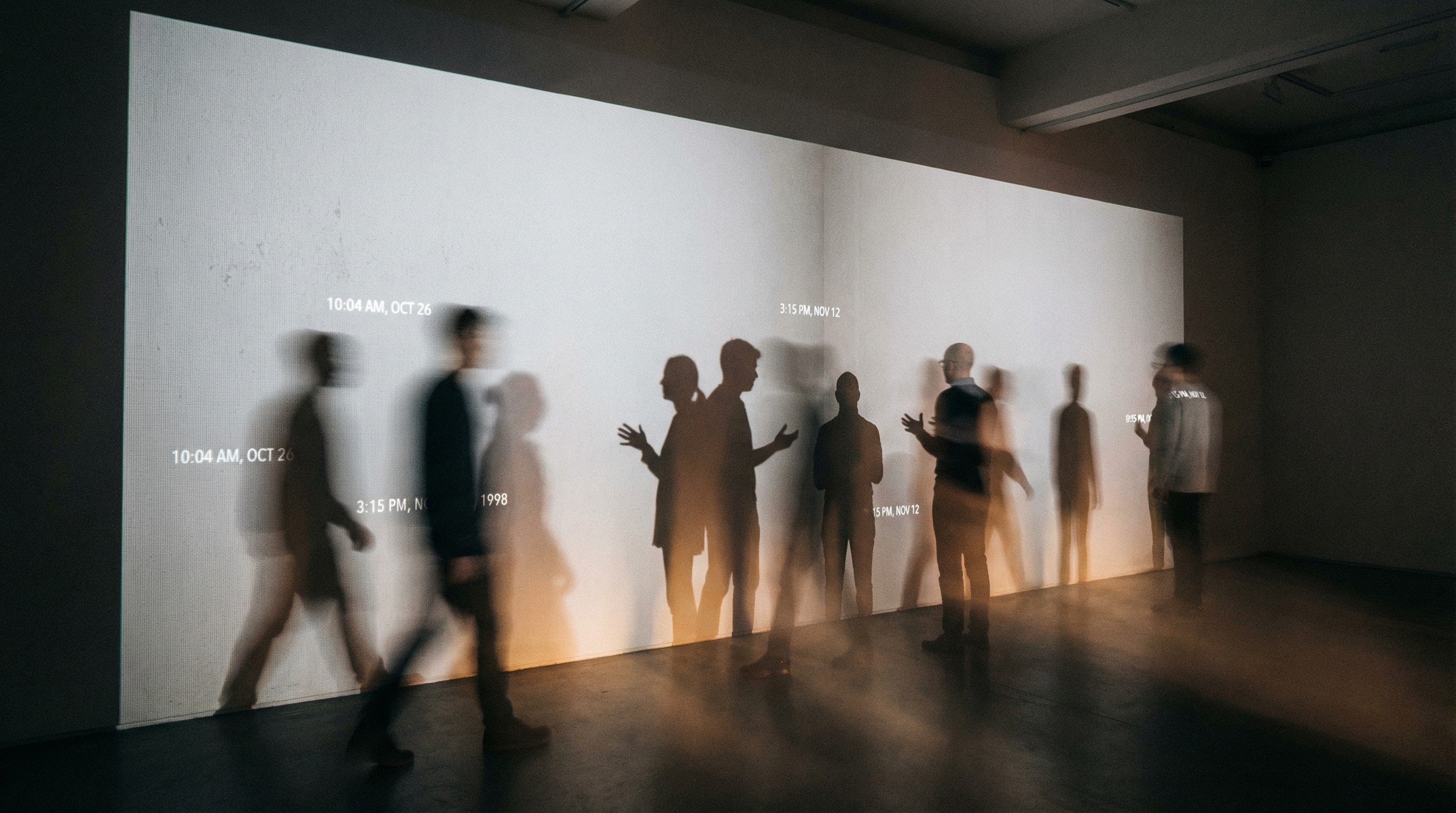
Bibliography — Or, The Graveyard of Intellectual Vanity
Let's Start with an Honest Confession
Looking at the list of books below, please don't think "Ah, Majikitchen is erudite." This is a tombstone of vanity.
Books we actually read, books we only quoted, books we only saw the titles of, books we only looked up on Wikipedia, books we wrote about based on hearsay—we'll honestly classify these. If academic honesty exists, we're about to thoroughly destroy it.
Note: this very act of "honest classification" is itself a form of intellectual vanity. By "admitting our ignorance," we appear more honest. This calculation is self-aware. Self-awareness doesn't grant absolution.
Classification Criteria — Or, Gradations of Dishonesty
We classify references into six levels. This is self-reported and unverifiable. We might be lying.
Level | Definition | Honesty |
|---|---|---|
A: Read through | Read from beginning to end | Rare |
B: Skimmed | Read only interesting chapters | Sometimes |
C: Preface only | Read only preface and translator's notes | Often |
D: Wikipedia | Read the Wikipedia summary | Frequent |
E: Secondary | Quoted quotes from other books | Habitual |
F: Fantasy | Haven't read but pretend we have | Shameful |
These classifications change over time. We forget books we read long ago. Can we say we've "read" a forgotten book? What is reading?—such philosophical questions let us justify our laziness.
Category 1: "Dépense" Works — Bataille and Friends
These are thinkers summoned to discuss "dépense" and "uselessness," the key concepts of this exhibition. By quoting them, "mere waste" transforms into "philosophical practice." Alchemy.
Georges Bataille, The Accursed Share
Level: B (Skimmed)
We read chapters on "the concept of dépense" and "theory of the accursed share." Got interested when potlatch came up. But gave up around the Aztec civilization and Tibetan Buddhism sections.
Honest impression: Bataille is interesting. Interesting but difficult. "Celebrating consumption as consumption"—we get the intuition. But whether we "understand" Bataille accurately is uncertain. When we say we "understand" Bataille, it means "we found a rationale to justify our activities using Bataille."
If Bataille saw this exhibition, what would he say? Maybe "that's not dépense." Maybe "dépense isn't this kind of calculated 'waste.'" We borrow Bataille's name without Bataille's approval. Dead people are convenient. They don't protest.
Roger Caillois, Man, Play and Games
Level: B (Skimmed)
Focused on the four categories of play (Agôn, Alea, Mimicry, Ilinx). Convenient for discussing 《Chariokart》.
Honest impression: Caillois's classification is memorable. Only four categories. We can memorize that. Memorable things are quotable. Our criterion for choosing philosophers: "quotability." Not depth.
Caillois and Bataille were friends who later fell out. Thinkers' friendships always break. Will we three also fall out someday? If we do, each will tell our own "correct" memories. Memory is fabrication.
Category 2: Psychoanalysis — Freud and Descendants
When discussing the human mind's darkness, psychoanalytic terminology is convenient. "Unconscious," "repression," "the uncanny"—using these words makes works seem deep. May not be deep, but seeming deep is enough.
Sigmund Freud, "The Uncanny"
Level: B (Skimmed)
Read the definition of "unheimlich" and passages about doppelgängers.
Honest impression: Freud's definition of "unheimlich" is roundabout. The negation of "heimlich" (familiar, secret) yet overlapping with part of "heimlich"'s meaning—essentially wordplay. But this wordplay carries strange persuasiveness. Convenient for discussing 《Shadow Dialogue》. Your shadow having a separate personality—that's exactly "the uncanny," isn't it?
Reading Freud makes everything seem reducible to sexuality. If Freud analyzed our works, would they acquire sexual meaning? 《Lifting Toilet》 as phallic symbol, 《Dazzring》 as exhibitionism, 《mouth2mouth》 as regression to oral stage—we can't confidently deny these interpretations.
Jacques Lacan, The Four Fundamental Concepts of Psychoanalysis
Level: F (Fantasy)
Pretended to quote "objet petit a" and "the graph of desire."
Honest impression: Haven't read it. Tried, gave up after 3 pages. Lacan is difficult. If Freud is roundabout, Lacan speaks alien. No idea what he's saying. But "quoting what you don't understand" adds depth to writing—we believe in this illusion.
What is Lacan's "objet petit a"? We can't explain. But using the phrase makes things feel psychoanalytic. "We pursue objet petit a"—sounds like we've read Lacan. We haven't. This is intellectual fraud.
Category 3: Post-Structuralism — The French Thought Brand
"Post-structuralism" sounds intellectual. Foucault, Derrida, Deleuze—these names make contemporary art seem legitimate. Contemporary art seems obligated to quote French thought. Not an obligation but a custom. Following custom is easy.
Michel Foucault, Discipline and Punish
Level: C (Preface only)
Quoted the "panopticon" and "disciplinary power" concepts.
Honest impression: Foucault's panopticon is famous. Too famous, perhaps clichéd. Everyone quotes panopticon when discussing "surveillance society." We're one of them.
Applied this to 《mouth2mouth》. AI constantly watches your mouth movements. May or may not be watching. This uncertainty changes user behavior—we constructed such a narrative. Post-hoc.
Jacques Derrida, Dissemination
Level: F (Fantasy)
Vaguely quoted "dissémination."
Honest impression: Derrida is unreadable. Characters are readable but meaning isn't. We don't trust anyone who claims to "understand" Derrida. We doubt even Derrida fully understood what he wrote.
"Deconstruction" is also unclear. But using "deconstruction" lets you critique anything. "This work deconstructs X"—that works as criticism. Convenient word. So convenient its meaning has evaporated.
Gilles Deleuze & Félix Guattari, Anti-Oedipus
Level: D (Wikipedia)
Quoted concepts like "rhizome," "deterritorialization," "body without organs."
Honest impression: Haven't read it. But "rhizome" is convenient, so we quoted it repeatedly. Rhizome means root-stalk, contrasted with tree structure—apparently. Not hierarchical but horizontally networked—apparently.
"Apparently" apologies. Many claim to have "read" Deleuze-Guattari; few claim to "understand." You can quote without understanding. Confessing "actually I don't quite understand" afterward is intellectual honesty—we claim.
Category 4: Phenomenology & Ontology — Tools for Discussing "Existence"
What is "existence"? No need to answer. Just posing the question makes things seem deep.
Emmanuel Levinas, Totality and Infinity
Level: E (Secondary)
Quoted the concept of "face" (visage) and relationship with "the Other."
Honest impression: Levinas is famous for discussing "the face." The Other's face commands me "Thou shalt not kill"—Levinas apparently said something like that.
The title 《face2face》 is Levinas-conscious. Conscious but haven't read Levinas. When saying "face-to-face," dropping Levinas's name adds depth. That's the only reason we include him in references.
Martin Heidegger, Being and Time
Level: F (Fantasy)
Pretended to quote "Being," "Dasein," "thrownness."
Honest impression: Heidegger is unreadable. Tried and failed. Among failed books, this was the fastest failure. Knew it was impossible after 3 lines.
But not including Heidegger in references feels like lacking qualification to discuss philosophy. Derrida, Foucault, Levinas all read Heidegger. Quoting without reading the source is academically dishonest. But we're not academics. Dishonesty is fine.
Note: Heidegger cooperated with Nazis. This raises questions about evaluating his philosophy. We have no opinion on this. Having no opinion isn't that we can't have one—we can't, having not read Heidegger. Having opinions about the Heidegger problem without reading Heidegger would be arrogant.
Category 5: Media Theory & Semiotics — Tools for Discussing Technology
When discussing media art, media theory vocabulary is essential. McLuhan, Baudrillard, Kittler—not using these names risks media art critics' anger. We don't want anger, so we quote.
Marshall McLuhan, Understanding Media
Level: B (Skimmed)
Quoted "the medium is the message" and "extensions of man."
Honest impression: McLuhan's "the medium is the message" is so famous it's clichéd. But clichéd or not, we must quote. 《mouth2mouth》 is "extension of the mouth," 《face2face》 is "extension of the face," 《Dazzring》 is "extension of the naked body"—McLuhan-style statements.
"Extension" is convenient. Make anything, and it's "extension" of something—you can say that. Technology extends humans. This claim is almost tautological. But even tautology seems deep when quoted.
Jean Baudrillard, Simulacra and Simulation
Level: C (Preface only)
Quoted "simulacrum" and "hyperreal."
Honest impression: Baudrillard's "simulacrum" means copy without original—apparently. The contemporary era has copies preceding originals—apparently.
《mouth2mouth》's AI-generated mouth might be "simulacrum." A mouth without original mouth. Copy of copy of copy. But whether this really counts as "simulacrum," we'd need to ask Baudrillard. Baudrillard died in 2007.
Category 6: Japanese Thought & Literature — Alibis as Japanese
Quoting only French thought risks being called "Western-obsessed." To avoid criticism, we quote Japanese thinkers. Alibi quotations.
Jun'ichirō Tanizaki, In Praise of Shadows
Level: B (Skimmed)
Quoted aesthetic of shadow, Japanese sense of beauty.
Honest impression: Actually read In Praise of Shadows. Read it, found it interesting. Tanizaki's writing reads as essay and novel simultaneously.
Tanizaki praises traditional Japanese aesthetics—dimness, shadow, ambiguity. Applied this to venue lighting. Not too bright. Having shadows. This is Tanizaki-esque aesthetics—we claimed post-hoc.
Actually, we just couldn't afford better lighting equipment.
Laozi, Tao Te Ching
Level: E (Secondary)
Quoted concepts of "wu wei" and "the use of the useless."
Honest impression: Haven't read Laozi. But know the phrase "the use of the useless." Useless things actually have use—something like that.
This exhibition's title "Useless Computations" is Laozi-conscious. Conscious but haven't read Laozi. Consciousness is only at word level.
Quoting Chinese classics adds Eastern depth—we believe in this illusion. May be illusion, but can still quote.
Category 7: Gender & Body Theory — Tools for Discussing the Body
When making works like Lifting Toilet and Dazzring, we can't avoid discussing gender and the body. Can't avoid it, so we gathered the tools.
Judith Butler, Gender Trouble
Level: D (Wikipedia)
Quoted: The argument that "gender is performative."
Honest impression: Haven't read Butler. But the phrase "gender is performative" I've seen many times. Basically, gender isn't essence but constructed through repetition of acts—apparently.
When discussing Lifting Toilet, Butler's argument was convenient. Standing or sitting to urinate. This difference in action constructs gender—we could speak Butler-style. Speaking Butler-style, but haven't read Butler.
Plato, Symposium
Level: C (Preface only)
Quoted: "Allegory of the cave"—wait, that's from Republic. Symposium is a dialogue about "Eros."
Honest impression: Put Plato's Symposium in references vaguely. Quoting Plato makes one look classically educated. Want to look classically educated, but don't feel like reading classics. Trying to resolve this contradiction through the reference list.
Symposium is a dialogue about "Eros." Eros doesn't only mean sexual. Desire for love, beauty, goodness—such lofty things Socrates and friends discuss. Our works have no such loftiness.
Plato, Republic
Level: E (Secondary)
Quoted: "Allegory of the cave."
Honest impression: Plato's "allegory of the cave" is famous. Prisoners in a cave, watching shadows on the wall. They think shadows are reality. But reality is outside the cave—that kind of story.
We quoted this allegory in the "Lighting Design" section. Our dim venue is like Plato's cave—we said. Post-hoc.
Category 8: Art Theory & Space Theory — Tools for Discussing Exhibition Space
Holding an exhibition requires citing art theory. Museum history, politics of exhibition space, ethics of curation—we must say something about these. Must say something, so we gathered the tools.
Brian O'Doherty, Inside the White Cube
Level: B (Skimmed)
Quoted: The concept of "white cube," the politics of gallery space.
Honest impression: O'Doherty's "white cube" is essential when discussing contemporary art. White walls, artificial lighting, separation from outside—these conditions make art works "art works."
This exhibition's venue is not a white cube. It's a Shōwa-era café. That's why citing O'Doherty has meaning. "We reject the white cube." Didn't reject it by choice—just couldn't afford to rent a white cube.
Walter Benjamin, The Arcades Project
Level: D (Wikipedia)
Quoted: The concept of "flâneur," descriptions of urban space.
Honest impression: Benjamin's Arcades Project is huge. Five volumes. No time to read five volumes. No time, so looked up "flâneur" on Wikipedia.
"Flâneur" means 19th-century Parisian strollers. People walking aimlessly through passages (arcades). We quoted this concept in the "Signage Plan" section. We want visitors to walk through the venue like flâneurs—we said.
Walter Benjamin, The Work of Art in the Age of Mechanical Reproduction
Level: C (Preface only)
Quoted: The concept of "aura."
Honest impression: Benjamin's "aura" is famous. Reproduction technology causes loss of artwork's aura—that kind of argument. What is "aura"? The singularity, uniqueness of "being here now"—Benjamin said. Apparently.
mouth2mouth's AI-generated mouth has no aura. Because it's digital reproduction. But having no aura isn't necessarily bad—we claim. The claim's foundation is thin.
Category 9: Miscellaneous — Books That Don't Fit
The following books don't fit into any category above. Putting unfitting things into "miscellaneous"—this act itself demonstrates the violence of classification.
John Berger, Ways of Seeing
Level: C (Preface only)
Quoted: The politics of "seeing."
Honest impression: Berger's book is a BBC program turned book. Books from TV programs should be easy to read—supposedly, but haven't read. Read only the preface, got the message "seeing is political."
Use: Work explanation for Shadow Dialogue
Books We Haven't Read but Pretend We Have
Title | Author | Reason Not Read |
|---|---|---|
Critique of Pure Reason | Kant | Too long |
Phenomenology of Spirit | Hegel | Incomprehensible |
Capital | Marx | Too long |
Difference and Repetition | Deleuze | Too difficult |
History of Madness | Foucault | Too long |
The Order of Things | Foucault | Too long |
Of Grammatology | Derrida | Incomprehensible |
Being and Time | Heidegger | Gave up after 3 lines |
People claiming to have "read" these are probably lying. If not lying, they're either extremely idle or extremely genius. We're not dishonest enough to lie, not idle enough to read, not genius enough to understand. So we honestly confess "haven't read."
Final Confession About Reading
We've listed references. While listing, we kept confessing "we haven't read these."
We're self-aware that this confession itself is a form of self-presentation.
"Honestly confessing we haven't read"—this act seems more moral than "pretending to have read without reading." But the desire "to appear more moral" drives this confession. Essentially, we're practicing "honest dishonesty."
Books You Should Actually Read
Finally, we'll list books you "should actually read" to understand this exhibition—is what we thought, but we won't.
Because you don't need to "understand" this exhibition.
This exhibition is for bodily experience, not intellectual understanding. You don't need to read Bataille to experience 《mouth2mouth》. You don't need to read Freud to experience 《Shadow Dialogue》. You don't need to read Butler to sit on 《Lifting Toilet》.
Reading philosophy books makes you feel like you understand works' "meaning." But understanding "meaning" and "experiencing" are different things. Sometimes thinking you understand "meaning" obstructs "experience."
So don't feel "I must read" looking at this reference list. You don't need to read. If you have time to read, come to the venue. Experience the works. Eat Napolitan.
If you still want to read—we won't stop you. But we warn: "you might not understand even if you read." Not understanding isn't your fault. It's the writer's (thinker's) fault, or your fault, or maybe nobody's fault.
Reference List Summary (By Reading Level)
Legend:
◎ Read through
○ Skimmed
△ Preface only
× Wikipedia or secondary
— Fantasy (haven't read but pretend)
Level | Author | Title |
|---|---|---|
○ | Georges Bataille | The Accursed Share |
○ | Roger Caillois | Man, Play and Games |
× | Marcel Mauss | The Gift |
○ | Sigmund Freud | "The Uncanny" |
— | Jacques Lacan | The Four Fundamental Concepts |
△ | Michel Foucault | Discipline and Punish |
— | Jacques Derrida | Dissemination |
× | Deleuze & Guattari | Anti-Oedipus |
× | Emmanuel Levinas | Totality and Infinity |
— | Martin Heidegger | Being and Time |
○ | Marshall McLuhan | Understanding Media |
△ | Jean Baudrillard | Simulacra and Simulation |
○ | Jun'ichirō Tanizaki | In Praise of Shadows |
× | Laozi | Tao Te Ching |
◎ | Albert Camus | The Myth of Sisyphus |
○ | Rainer Maria Rilke | Letters to a Young Poet |
Afterword — References as Performance
A reference list is a kind of performance.
"We've read this many books"—performance. "We have education"—claim. "Our works have intellectual backing"—advertisement.
But through this performance, something paradoxically becomes clear. That is: "references are decoration."
A work's value isn't determined by reference quantity. Reading Bataille doesn't make boring works interesting. Not knowing Derrida doesn't make interesting works boring. Reference lists are just "garnish" for works.
Then why did we make such a long reference list?
Simple answer: it was fun.
Talking about books we haven't read. Pretending to have read. Confessing we haven't. This series of acts was fun. Fun things don't need meaning. Perhaps meaningless fun is the essence of "dépense."
—thus we conclude quoting Bataille. Using Bataille to the very end. We're grateful to Bataille. Grateful but never met him. Can't meet him. Bataille died in 1962.
Dead people are convenient. They don't talk back.
"Cooking needs fire, not recipes. Exhibition needs your presence, not references."
You don't need to read these books. Works can be experienced without reading. Even if you read, no guarantee of deeper understanding. However, reading is a useless act, valuable in itself.
And you who read this lengthy reference list to the end have practiced "useless reading." Congratulations. Or condolences.
From the kitchen with irony and humor.